
The First 48 Hours: The Power We Handed Over to the System: Oleg Vojtíšek, Olga Nešporová, Magdalena Ondrová, Barbora Steinlauf
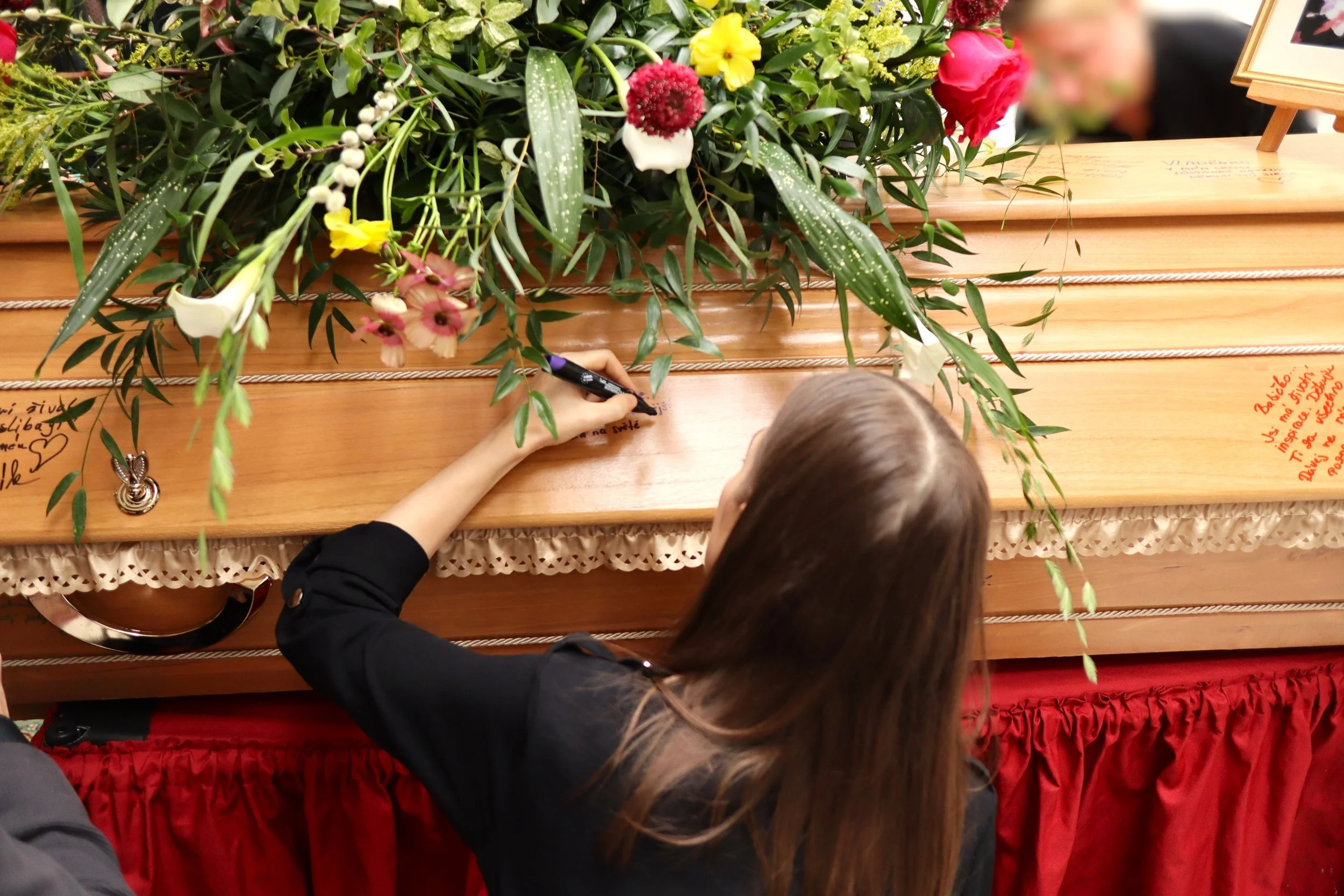
At a funeral, we can write messages on the coffin.
Dad has died. And now, quickly: call a doctor, search the internet for the nearest funeral service, and have them pick him up as soon as possible. First thing in the morning, go arrange the funeral at a branch office, ideally before work. Order wreaths, put together a death notice, choose a coffin from a catalog. That is what the most classic 48 hours after a death look like.
Olga Nešporová, an ethnologist from the Czech Academy of Sciences, notes: "People have stopped being used to caring for the dying. We don't know what to do with the deceased, and we are afraid of their physicality and potential changes."
A dead human body is not biological waste, however. As our Oleg nicely puts it: "A dead person no longer breathes, coughs, or sneezes. Bacteria may be there, but they love our living 36 degrees. If you weren't afraid to touch them in life, there is no reason to pull away now." The first few hours after death belong to you and them, not to funeral attendants.
Magdalena Ondrová from the hospice adds practical examples: in hospices, it is normal for nurses to help the family wash, dress, and generally prepare the body. Sometimes the family wants to style the hair, other times give them something to take along on their journey. And sometimes someone just needs a phone consultation on how to do it.
All three experts across fields agree on the same thing: we are afraid of death and we are afraid of the dead body. Yet caring for it can help us immensely. The deceased is already calm, nothing hurts them, and you have them fully in your hands. That peace transfers to you when you give yourself the chance. To say goodbye, do them a final service, and care for them one last time. And only then let them go.
If you want to learn more about the first 48 hours after a death—what your rights are and what no one is allowed to forbid you—read Klára Nesitová's interview with our Oleg, as well as Olga Nešporová, Magdalena Ondrová, and healthcare attorney Barbora Steinlauf.
Would you like a tree to grow from your body? And did you know that isn't possible here? Ekonews reports on the conference Together for Terramation
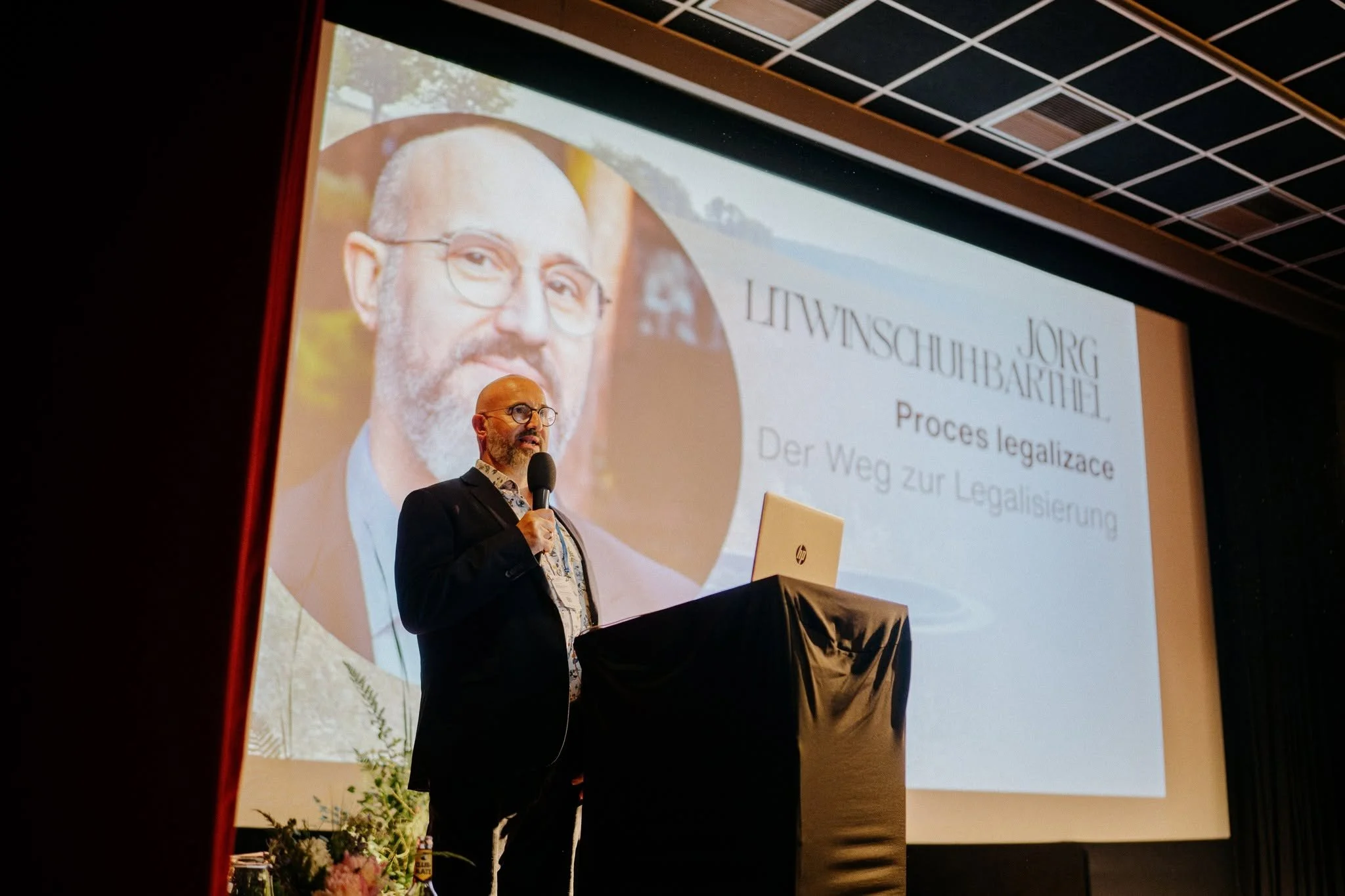
Jörg Litwinschuh-Barthel on the legalization of terramation
Would you like a tree to grow from your body? And did you know that isn't possible here?
Well, not quite: here, any tree burial must be preceded by cremation. So only your ashes are poured around the tree. And since ashes are mostly phosphorus and calcium, the tree mostly just tolerates you rather than being helped to grow by you.
(A rarer exception is, of course, cemeteries where trees were planted and then allowed to grow so wildly that their roots grew through the graves. No one can be newly buried there in a coffin without cutting down the tree, but it's proof that it is possible – when there's a will!)
But how to make it actually possible? How to truly transform into useful soil that gives rise to a tree? And how to do it within dozens of days, when a body normally takes decades to decompose?
This is what the German company Meine Erde looked into. They came up with a "cradle" where a deceased person's body decomposes in 40 days through natural processes: moisture, warmth, and gentle movement. Once the process is finished, you are left with terramate – soil, earth, in which a tree can theoretically be planted.
Except: even in such a progressive country as Germany, this soil must be transported to a cemetery and buried several meters deep.
And now the crucial question – can we do this here as well?
No funeral home has the technology (the cradle) to do this yet. But we don't see any problem with that: we can arrange the transport of the deceased to Germany, and then the transport of the terramate back to us. We will take care of the necessary paperwork.
However, it would be completely ideal without transport and without issues with our laws. This is what the Last Trace association, led by Adam Vokáč, is striving for.
The ministry's statement reads (among other things): "Ecological criteria and moral sentiments can diverge significantly, while in the field of burial and handling human remains, a violation of the public's moral sentiment is judged as a potential offense under the Burial Act."
So what do you think? Is it an offense? Is it an ecological problem? Is it a violation of public moral sentiment in a place where, according to the ministry, cremation is not considered such a violation?
Read the article by Irena Buřívalová on Ekonews about the conference organized by Adam Vokáč and the Last Trace association, which was also attended by our Oleg Vojtíšek:
Oleg Vojtíšek: A funeral should help, not harm: An interview in Ľudia a Zem magazine
Oleg Vojtíšek and Adam Krecl, article author
An interview full of questions. And answers.
What is your relationship with death? I assume that after all your experience, you aren't afraid.
Was the idea of founding a funeral service driven by any negative experiences?
On the contrary, your organization also features young female guides. How do they handle a profession where age plays a role?
What skills does a person need to master to become a funeral guide?
Is death still a taboo in Czech society, or is the situation improving?
Do you have any experience with funerals abroad?
Is there a country whose funeral rituals you would like to see with your own eyes?
Where do you look for inspiration for funeral formats in the Czech Republic?
Are you succeeding in transforming Czech mourning rituals?
Your website features the phrase "a good funeral." What does a good funeral mean?
That reminds me of Mexico, where people believe that the departed stay among us...
During my studies in social anthropology, I also came across the Indian ritual of sati, where a widow is ritually burned alive with her husband's body. Have you ever witnessed anything like that?
Can you personally help the bereaved with grieving after the funeral?
People often embark on journeys during major life changes. Can you also prepare a symbolic journey for the bereaved?
You also offer burials in a natural woodland cemetery. How did you come up with that idea?
Why should I choose a woodland burial instead of a traditional city cemetery?
Do people come to you asking to hold a funeral a second time?
What types of funerals are currently the most popular among the bereaved?
Do people plan their own funerals in advance?
As a funeral guide, which part of the process do you find the most difficult?
How can I prepare myself for death?
How not to fear death? It is easier than it seems. Tips for overcoming fear from a funeral guide
The fear of death can be eased
Want to know how to overcome the fear of death? It's easier than you think: Just accept it. Give it a symbolic kiss of acceptance. That's our secret trick. All those anxieties and that nagging feeling that things are out of your control? Most of the fear of death disappears once you understand and accept that it's simply part of the package called life.
Our Oleg Vojtíšek wrote an article for Vlasta magazine, where he talks in a popular and simple way about things like:
1. Talk about death
2. A funeral is your last big project
3. Want peace of mind? Talk to the pros!
4. Leave a message
5. Annual check-up
6. Live every day as if it were your last
7. You can practice for the death of a loved one
Go ahead and read it. Maybe it will inspire you.
Death can be calm and peaceful, says funeral guide. I talked about death with my grandmother
Funeral guide Renata at the forest cemetery
Death can be calm and peaceful, says funeral guide. I talked about death with my grandmother
"A terminally ill man in his fifties reached out to us, and together with him and his family, we are preparing for the end of his life. I am in contact with him, writing a speech that he approves. It is an amazing story. When I visited them, I was fascinated by the humility and acceptance with which they embrace their destiny."
Renata Svoboda, our Ren, started working in the funeral industry because the experience of guiding her grandmother opened the door to a completely new life.
A life where she wanted to dedicate herself to the dying and those they left behind. Accompanying a family from the moments before death through the funeral and often even beyond is simply part of the work Funeral Guides do, and we are so glad Ren took this on with such care and compassion.
If you are interested in her story and her profession, read about it in a new article on Flowee. It also touches on whether our profession can turn into a cold, insensitive business centered around death.
Our colleague Renata shares with Květy magazine how she accompanied her grandmother on her final journey

From the stories of our clients, we know that spending their final moments with loved ones is a gift ♥️ that changes people's lives.
🛤️Our colleague Ren Svoboda accompanied her grandmother on her final journey surrounded by family 👫
And that is what later motivated her to become a funeral guide 🏡
You can read more about how she handled the situation with her grandmother in Květy magazine 🌺
What to say and not to say to parents after the death of a child
Do you know someone who has lost a baby or an older child? Would you like to comfort them somehow, but don't know how? Prepare yourself for the fact that you simply cannot take away the pain of parents who have lost a son or daughter; it is beyond human capability. On the other hand, words can be powerful, and you can either bring comfort to a grieving parent's soul or deeply wound them.

Adriana Kábová on the banks of the Vltava River, on Střelecký Island
When my own baby died, I was surprised by many of the reactions from people around me. Some were kind, others unpleasant. What shocked me the most was how many people pulled away and pretended nothing had happened. I realized they probably didn't know how to react. But avoiding me, or at least avoiding the topic of the child's death, is what hurt me the most.
After a child's death, parents often find themselves in a strange vacuum and feel very lonely. This happens simply because those around them don't know what to say or do, so they prefer to pull back and avoid reacting to such a difficult life situation. Fears of bringing up the deceased child are misplaced; for the first few months, parents can barely think about anything else.
Alongside ignorance, a common type of reaction is a desperate effort to come up with something positive—something to cheer up parents with empty arms. But that simply cannot work. The parents can sense the effort to comfort them, but it completely misses the mark.
Sometimes I was amazed by what people said to me. I understand they probably felt the need to comfort or cheer me up. But more than once, it ended up making me feel sorry for *them*, struggling as they were and not knowing how to act around me.
I recommend focusing instead on sentences that acknowledge the death of the child and the weight of the parents' grief. A simple “I'm sorry”, “I am so sorry” is sometimes completely enough. “My deepest condolences” might be seen by some as a stiff phrase, but it actually holds deep meaning and certainly belongs among the most welcome expressions of sympathy.
Words that can support grieving parents:
I am so sorry.
I am deeply sorry.
My sincere condolences.
If you know each other very well, offering a hug can be a source of support for parents after the death of a child. It is always best to ask first if it is okay and if the parents would be comfortable with it at that moment. Respect their answer without judgment if they decline your offer; not everyone is a "hugger."
I am here for you and will listen whenever you need.
Don't hesitate to write to me anytime; you will never be a bother.
It is very important to know how to listen to parents after the loss of their child. Often, they need help sharing their burden, but very few people want to hear about dying. Hold back on sharing stories about what happened to people you know and what helped them. Instead, focus on the story or insight that the grieving person might want to share with you, but often find no space to do so. Let the parents know that you are ready to listen. You can say something like "I am here for you and will listen whenever you need" or "don't hesitate to write to me anytime; you will never be a bother."
Would you like to tell me something about (child's name)?
And when you are figuring out whether parents are in the mood to share their grief with you, it is good not to be afraid to mention the name of the deceased child. Many people tend to stop saying the child's name, as if it suddenly became forbidden. Yet, for the parents, they are still their beloved son or daughter, even though they are no longer here. And when no one wants to talk about them or even say their name anymore, it feels as though those around them suddenly refuse to acknowledge that they ever existed.
I was always touched when someone among my acquaintances was not afraid to speak my son's name. It warmed my heart that at least someone remembered him, even though he was here for such a short time.
Words that usually rub salt in the wound:
Be glad you still have another child.
You are still young, you will have more.
You just have to think positively.
Worse things happen to people.
I know how you feel because...
Nature wanted it this way. It was meant to be.
Your child is in a better place now.
At least they weren't older.
Are you thinking about having another one?
Sentences starting with "at least."
Aside from the group of people who worry about hurting the parents with their words and prefer to stay silent, there is another group that doesn't think before speaking at all and simply blurts something out, believing it will lessen the parents' sorrow. If the parents have other children, someone will always make sure to mention it. "Be glad you still have another child." Yes, parents are certainly glad to have another child, but that does not lessen their grief in any way. Similarly ineffective are virtually all sentences that begin with "at least…" At least you are okay, at least it didn't turn out even worse, at least everything else is going well for you, at least you can still have more children, and so on.
And then there are those who feel they know exactly what parents go through after the death of a child. Because someone they know went through something similar, they know what helped them and what the parents should or shouldn't do, and what they need. Never say the sentence "I know how you feel because…" because you simply do not know. Every grief is deeply personal, and no one can give parents a precise guide on how to navigate it.
"When our Oliver died, I wasn't able to speak to anyone except my husband. After returning from the hospital, we stayed at his parents' house for a few days. Everyone acted as if nothing had happened. On the third day, my mother-in-law sat down next to me in the living room and said she knew exactly what I was going through. She apparently had a miscarriage once. She started giving me advice on what I should and shouldn't do now. I just stared at her. And I told her she had absolutely no idea what I was going through. I walked away in tears, and we didn't speak to each other again until we left."
An experience from our client Eva B.
Well-meaning judgments like “nature wanted it this way”, “it was meant to be”, or don't help either
“your child is in a better place now”. If these statements are meant truly seriously, they contain a reference to spirituality that the parent may not share with the speaker.
And because grief shown in public is generally not very common in our society, people around parents sometimes do not know how to handle it. That is how remarks like “don't cry, it won't bring him/her back anyway” or “above all, you have to think positively” come about. Similarly, the remark “other people have it even worse” is not supportive at all. The pressure to smile and encouragement to suppress grief deny the parents' experienced emotions and their need to mourn.
A sentence that can hurt parents of babies who died stillborn or were born very prematurely goes: “at least it wasn't older”. Watch out, direct comparison does not apply here. The parent simply lost a child. Period.
When it comes to babies, spare yourself the frequently heard sentence “you are still young, you'll have another one”. Parents are experiencing indescribable pain, grieving precisely for that unique baby they have just lost. This sentence feels like a slap in the face. Furthermore, you may not know the exact reasons for the baby's death, and sometimes procedures occur after which another pregnancy is no longer possible. And if you haven't stood by the parents' side throughout their grief and aren't among their absolute closest, completely avoid asking such questions when you bump into them so that you don't end up having to talk about: “And are you already thinking about another one?”
So we recommend definitely not ignoring a child's death or passing over it in silence. It's just that in such a case, less is sometimes more, and “I'm sorry” and " I am so sorry" as a first reaction are completely enough. And then you can ask the parents what practical things you can help them with, or perhaps suggest some directly. What is valued most is being able to listen to the parents and everything they want to share, perhaps even repeatedly.
The author, Adriana Kábová, is a grief counselor and funeral guide who lost her first baby.
How nature helps us in times of loss
When we lose someone close to us, the world as we knew it suddenly changes. Time seems to stand still. What once felt solid falls apart. What used to make sense suddenly makes none at all. The pain can feel heavier than we are able to bear. An emptiness forms. A silence that cannot be bypassed.
It is precisely in such moments that nature can become our support and sanctuary. It offers what we so deeply need in times of grief – silence, peace, a healing sound, a sight, and a touch. A space to rest. Closeness without words, without advice, without pressure. It helps us gently stay connected – with ourselves, with what was, and with what remains.
We, Funeral Guides, have now begun establishing natural burial grounds. That is why we dedicate much more attention to the connection between nature and mourning in our articles as well.

Nature accepts and heals
In moments of grief, nature can be the most patient guide. The forest, mountains, river, and open sky do not force advice or quick solutions upon us. They do not promise that "things will be fine again" nor do they provide instant guides on "how to feel good quickly." They do not judge, rush, or pressure time – they are simply there in quiet presence. They accept our sadness as naturally as morning mist or fallen leaves. And by doing so, they give us the space to simply be. To meet our grief, stay with it for a moment in the present, and pay attention to it.
During the grieving process, it can be difficult to stay in the present. Presence itself often hurts – we tend to reminisce, dwell in the past, feel regret, withdraw, numb ourselves, or avoid what we feel. Yet it is precisely then that nature offers one of its gifts. It helps us gently stay here and now – with what we feel and what surrounds us. It becomes a sanctuary even for the heaviest of emotions.
The peace, rhythm, and quiet strength of nature gradually guide us back to ourselves, into our bodies, and to our feelings. In the infinity of the sky, we can find calm and feel that it can hold even our grief. When we lean against a tree, we sense a quiet strength supporting us. In the solidity of stone, we find stability amidst an emotional storm. A leaf carried by a current of water can symbolically wash away a piece of our pain. And just as the earth accepts the rain, it also accepts our tears.

Nature seems to naturally attune to our pain without dismissing it or considering it too great. We can turn to it as a silent witness to our sorrow. And even though outwardly nothing seems to change, its presence usually fills us with greater lightness and peace. Perhaps it is in this quiet resting that a gentle wave of acceptance begins to awaken within us – as if we suddenly perceive everything with greater perspective and open up to accepting what is.
The body feels loss too
Grief does not reside only in the heart – it leaves traces in the body as well. In times of loss, people often describe chest pain, constricted breathing, insomnia, an upset stomach, anxiety, anger, or the onset of autoimmune issues. The nervous system, overwhelmed by intense emotional pain, shifts into a state of constant alert – as if the body cannot find peace, safety, or rest. And when the body is tense, it is difficult not only to function, but also to process grief.
And it is precisely in such situations that nature can help us significantly. Scientific studies confirm that spending time in nature harmonizes the nervous system: it calms breathing, lowers blood pressure and stress hormone levels, and boosts immunity and emotional resilience. It helps improve mood and eases anxiety – symptoms that often accompany grief. From Japanese tradition comes the term shinrin-yoku, literally "forest bathing." It refers to forest therapy, which originated in the 1980s as a response to the growing stress of modern life. It is not about performance or hiking – it is an invitation to slow down and be present with all your senses among the trees, light, scents, and sounds of the forest.
Nature quietly works on our physiology: it is enough to walk through the forest and feel the softness of the moss. To smell the pine needles. To stop by a tree and let patches of light filtering through the canopy fall on your face. To notice small insects making their way among the leaves. To feel the roughness of the bark with your palm and listen to the silence in which our breath slowly calms down.

In this silence, a deeper perception begins to awaken within us – we are not just thinking beings situated in nature; we are nature. Our bodies, like the trees, wind, and soil, are closely connected with the natural world. And it is precisely in this connection that our senses open up, our sensitivity to ourselves and our surroundings grows, our mood gradually shifts, and our body can breathe more freely again.
A conscious memory anchored in nature
Nature can also support us in anchoring a conscious memory of a loved one who has passed away. When someone dies, not only does their physical body disappear, but their place in our life changes too. They are no longer on the other end of the phone, at the table, visiting… and yet they remain. In memories, gestures, words, in what we took away from them – in our hearts. It is this inner presence that can be healing if we give it space.
Giving memory space means accepting that a relationship does not end with death, but rather changes its form. In the silence of nature, we can ask ourselves: What of what we lived together do I want to preserve? What do I want to carry forward as a memory, a gift, an expression of gratitude?
Nature offers gentle, concrete stimuli for this. A feather that we stick into the moss. A word whispered into a tree hollow. A leaf that we let float away down a stream as a silent message. A stone that catches our eye with its shape and into which we press the love we continue to carry in our hearts. A conscious memory can thus take on shape, voice, and expression.

The legacy of ancestors in the rhythms of nature
Our ancestors lived in close connection with nature and its cycles. Death was not a taboo for them, but a natural part of life. People said goodbye by a fire, with singing, in a circle of family and community. The body of the deceased was laid into the earth – in the forest, on a sacred hill, under a stone – in a place that was part of their life. Mourning had its time, space, and rituals that helped with the return to life.
Today, we can consciously return to this wisdom and build upon it. We can let ourselves be inspired by the acceptance of life in all its forms. We can seek kind and natural ways of saying goodbye. And we can lean on the rhythm of nature, which was here long before us and will remain long after us – on sunrises, changing seasons, the cycle of birth and departure. A rhythm that knows death as a part of life. A rhythm in which nature offers quiet support and a space where we are allowed to grieve at our own pace – without haste, with respect for what was, and with the hope that life will slowly find a new balance.

In times of loss, nature offers us quiet yet powerful support. It can carry everything that hurts us – tears, silence, and memories. We find support in it to honor the memory of our loved ones, to pause, listen, and rest. It can also help us reflect on our own mortality and find comfort in the knowledge that even though we are navigating the complex terrain of grief, we are not alone in it. We thus build upon the approach of our ancestors – with respect and humility toward life, in reconciliation with death, and by finding support in the rhythm of nature.
In the peace of nature and the repeating changes of its cycles, we find inspiration on how to navigate sadness, how to allow ourselves to experience pain while also being guided toward reconciliation – toward coming to terms with our loss. It gently leads us back – to ourselves, to life, to a new beginning. In its quiet rhythm, a gentle movement toward balance, renewed resilience, and wholeness can quietly be born. And that is precisely where its deep wisdom and comfort lie.
Final Farewells in the 19th Century
Many people today wish to die at home, surrounded by their loved ones. In the past, this was perfectly common—especially in rural areas, where a person’s passing was associated with a host of traditions and customs. These rituals were intended to symbolically sever the ties that bound the deceased to family and neighbors, while also welcoming them into the world of the dead. In this article, I explore how death and funerals were experienced in the Czech countryside during the 19th century. Many of the customs from that time survive to this day—albeit perhaps only in a simplified form.

Funeral ceremonies have always been accompanied by a whole series of rituals.
Dying
When someone was ill for a long time, neighbors would bring them all kinds of medicines, and the family would pray for their recovery. If the sick person felt that their final moments were approaching, they would say goodbye to family and friends, bestow blessings upon them, and give final instructions regarding the distribution of their estate. At the same time, however, this created an opportunity to pass on messages to those who had already died. People used their approaching death as an opportunity to send greetings to “the other world”—they talked about what had happened in the village; about misfortunes, the war, but also about those they missed.
“Aunt Hotáková pleaded: ‘Please give my regards to my husband—Martin—and tell him that our house burned down this summer… Tell my parents that Šimon was drafted this year and that he’s already enlisted in Pilsen.’ The widower, who had buried his wife five years ago, recalled poignantly: ‘Give my regards to my Manka, too; tell her I can’t forget her—I just can’t.’ All morning long, people came to the cottage with their sorrows and longings, and the old woman smiled, prayed, and promised that she would faithfully pass on everything…”
– Jindřich Šimon Baar of Postřekov in the Chodsko region. In: Navrátilová. 2004: 189.
Signs
When an owl hooted or a female dog howled in the yard, people used to say that death was approaching. In Central Bohemia, people imagined her as a female figure in a paper dress standing by the bed of the dying person. Other omens of an approaching end included a clock suddenly stopping or strange noises in the house—“like a rod striking a chest.”

At Easter, there used to be a procession to the cemetery on Palm Sunday (now known as White Sunday).
Reporting a Death
As soon as a person took their last breath, everyone sleeping in the house had to be woken up. If the head of the household died, his passing was also announced to the animals—the dog, the horses, the bees, and even the fruit trees. When the lady of the house died, the news was primarily conveyed to the poultry and livestock. Inside the house, clocks were stopped, mirrors and paintings were covered, the deceased’s eyes were closed so that he would not “spot” anyone else, and his chin was tied up so that he would not “swallow” anyone from the family. Everything was done with respect for the body, because it was believed that the soul remained with the body until the funeral. This was also why vessels were turned upside down, so that the soul would have nowhere to hide. In some regions, a window was opened after death; in others, it was closed—depending on whether people believed the soul should stay or leave.
Even today, in villages, the noon death knell can signal that someone has died. In some regions, it used to be customary to “ring the bell” a certain number of times—three times for a man, twice for a woman, and once for a child.
The family would then ask someone to go around to the neighbors and tell them what had happened. In return, the person received a small token of appreciation—a snack or some money—but was never allowed to enter the house. This custom was later replaced by an obituary in the local newspaper.
Placing the body in the coffin
Before the body was placed in the coffin, an older woman from the family or among the relatives washed it. Anything that came into contact with the deceased during this process was no longer used—it was burned or buried. The water was poured into an unused corner of the garden, a place where people did not normally go and where nothing was grown. The deceased was laid on a white sheet, or on a bier in a cool chamber, with the head turned toward the east.
The coffin was custom-made by a local carpenter and blessed with holy water before use. A family member dressed the body—often in a linen gown or a wedding dress—with the hands crossed over the chest and a holy image placed between them. A rosary, a cross, a prayer book, or personal belongings were also placed inside. The body was then laid out in the house. Shoes were not placed on the body—they were expensive and were passed down to others. In the 19th century, the coffin was usually black. For those who died unmarried, however, it was sometimes red.

Items that the deceased had loved—such as tobacco, alcohol, a book, photographs, or even musical instruments—were often placed in the coffin as well.
Lamentations and Final Visits
Neighbors and acquaintances came to visit the family and the deceased. They prayed, said their goodbyes, and holy water was placed next to the body for making the sign of the cross. Beggars were also invited to pray for the deceased, and female beggars—known as “mourners”—loudly wept for him. In some regions, the prayers lasted all night. Guests sang funeral songs with the family, and in addition to prayers, tea, coffee, light refreshments, and even alcohol were served. Guests often took the leftovers home with them.
Carrying the Deceased Out of the House of Mourning
The coffin was not closed until just before departure for the cemetery—so that everyone could say goodbye to the deceased right up until the very last moment. The act of nailing the lid shut was often accompanied by intense emotions, weeping, and wailing. The coffin was always carried out of the house feet-first—this was supposed to prevent the deceased from “returning.” This custom has survived to this day.
The threshold of the house had symbolic significance; it marked the boundary of the home. When carrying the coffin, the bearers would either swing it over the threshold three times, tap it against it, or make the sign of the cross over it. If a woman died during the postpartum period, women carried the coffin. Similarly, a married man was carried by married men, and an unmarried man by unmarried men.

The coffin was most often carried by men, usually married men. In the past, the coffin was carried on a bier; today, it is more commonly carried by its handles.
Funeral procession
From the house of mourning, the coffin was carried to the church or directly to the cemetery—either on a bier or on a horse-drawn cart. When traveling by cart, it was first backed up three times. During the journey, people prayed; in some places, a singer led the prayers.
At the edge of the village, often by a wayside shrine, those present would turn to the others one last time to ask for forgiveness:
“Neighbors, if the deceased wronged you in any way during his or her lifetime, I beg you, for God’s sake and for the sake of all the saints—once, twice, three times—to forgive him or her!” Those present respond in unison: “May God forgive him or her.”
– Žipek, 1895: 534. In Nešporová, 2013: 188.
If the church or cemetery was far away, young children and the elderly would accompany the procession only as far as the edge of the village.

Today, coffins are most often transported by car, but in the past, men carried them by hand, and only later were they transported by carriage.
A ceremony at the cemetery
Upon arrival at the cemetery, a religious service was held, during which the priest delivered a sermon, consecrated the grave, and the coffin was lowered into the ground. People usually could not hold back their tears—crying and grief accompanied the entire ritual.
To this day, it is customary to throw three handfuls of dirt onto the coffin—a reminder that we will all end up the same way someday. In some regions, the deceased’s bed was also made on the day of the funeral: if it remained undisturbed the next morning, it was believed that the soul had not returned.

In the past, the deceased was laid to rest on the very same day they died. However, there was a risk that someone might be buried alive by mistake—people used various methods to confirm death, such as dripping wax onto the chest or placing a feather against the mouth. It was precisely for this reason that a decree was issued in 1771 stipulating that every church must have a mortuary where the body would remain for at least 48 hours. In reality, however, this rule was not followed until much later.
Kar
After the funeral, the family invited the guests—relatives, friends, but also the priest, the professional mourners, the gravedigger, and the pallbearers—to the funeral feast. Simple foods such as porridge, bread, milk, and often alcohol were served.
A Posthumous Wedding
Wedding motifs often appeared in the funerals of unmarried deceased individuals—this was meant to complete the life cycle that death had interrupted. The deceased young man or woman was dressed in wedding attire, and one of their peers would symbolically take on the role of the groom or bride and walk behind the coffin. In some regions, the procession was accompanied by two figures—a white bride and a black bride. The black bride carried a broken candle as a symbol of a life cut short.
The bridesmaids often accompanied the deceased from the house, and the feast that followed was informally called a “věneček,” a “veselka,” or simply a “wedding.” People gathered there to eat, drink, and dance together. Bread was also served.

The tradition of white and black brides has survived to this day in some regions of the Czech Republic and Slovakia.
A Time of Mourning
The funeral was followed by a period of mourning; women wore black clothing or at least a black armband. For one year, no weddings were allowed, and the family did not attend dances or celebrations.
Excessive grief, however, was frowned upon—it was said to unnecessarily disturb the soul of the deceased. People mainly mourned on the anniversaries of death and birth, on All Souls’ Day, or at Christmas.

Visiting the cemetery on All Souls’ Day remains an important tradition to this day. In the past, special pastries made from white flour were baked for this occasion—they were called “dušičky,” “kosti svatých,” “caletky,” or “boží kosti.” These were distributed to children and beggars. It was believed that they, in particular, were close to the spiritual world and could facilitate contact with the dead.
Grave Maintenance
In the past, graves were not maintained as carefully as they are today. They were often overgrown with grass, and when the family mowed it, the gravediggers took offense—because they grew vegetables there, cut grass for their livestock, or grazed their animals.
Larger and more ornate graves began to appear toward the end of the 19th century, first in cities and gradually in rural areas as well. Most had only simple markings; inscriptions were rare. Wealthier families could afford a wooden or metal cross. In Central Bohemia, colored crosses were used—red for unmarried people and black for married men or women. Around the turn of the century, wreaths and the lighting of candles on the anniversary of a death or on All Souls’ Day became common.
Funeral customs in our country varied significantly from region to region. In fact, it is perhaps at funerals that the saying “Different regions, different customs” applies most. If you have experienced any other traditions that were observed in your area, we’d love for you to share them with us—please write to us at [email protected].
The author is Adriana Kábová, an ethnologist and funeral guide.
Sources:
KAŠOVÁ, Lucie. Funeral Rituals, Customs, and Traditions in the 21st Century in Jílové u Prahy. Master’s thesis, advisor: Pavel Hošek. Charles University, Protestant Theological Faculty, Department of Religious Studies, 2011.
NAVRÁTILOVÁ, Alexandra. Birth and Death in Czech Folk Culture. Prague: Vyšehrad, 2004.
NEŠPOROVÁ, Olga. A Century of Changes in Burial Practices: From Church Burials to Cremation Without a Ceremony. Český lid, 100, 2, 2013.
ŠROM, Boh. On Rural Life in the Jílové District, manuscript, 1895.
ŽIPEK, Josef. Superstitions and Customs Concerning Illness, Death, and Funerals in the Strakonice Region. Český lid, 4: 533–535, 1895.
Šechtl and Voseček Digital Photo Archive
A Beautiful Funeral? Yes, It's Possible. By Oleg Vojtíšek for Marianne magazine.

To borrow the words of Oleg Vojtíšek, their organization strives to transform something that was perceived as depressing, bad, and terrible into something beautiful that helps and brings reconciliation.
"Fortunately, today you can organize a memorial service however you like," says Oleg Vojtíšek, founder of Pohřební průvodci, in an interview with Marianne magazine. Those who have done so all agree that it was a beautiful experience.
“A personalized funeral helps,” says Oleg Vojtíšek, founder of Pohřební průvodci, an association that helps bereaved families organize a more personalized final farewell for their loved ones, confirming my assumption.
“It should take place at a location connected to that person—somewhere they loved or where we want to go to remember them. For example, by a river, in a park, or at a villa.”
"With the people he loved and who loved him—or even those who didn't, but who want to make peace," he continues.
“What brings me the greatest joy is that people come up with their own ideas about where the ceremony will take place and what will happen during it, and they call us with a specific vision, which we simply help them refine and bring to life. The result is truly their own ceremony—a personal one that reflects how the deceased lived and how they lived with him or her,” she notes optimistically.
How to Talk About Death and Why Are We Afraid of It? Adriana and Oleg for iGlanc.

“Grandma went to heaven.”🌌
How many times have you resorted to saying “she’s in heaven” when your child asked you where Grandma had gone?
We think this will make the child feel better, since they're still too young to understand the complexity of death. And most importantly, so they won't be afraid that death will happen to someone else.😱
But we don’t even consider the fact that around the age of ten, a child will inevitably come to understand death on their own—we’re just wired that way. By filling their heads with false ideas, we only make it harder for them to grasp the concept of death.
What are the right and wrong ways to do this? We asked our colleague about her own experiences:
🐶When the family dog died, my parents didn't say anything about it for three days. When I started asking about him, they said he had simply passed away.
💔She remembers very clearly the moment when she became aware of the reality of death: she must have been around nine years old; she was in her bedroom, getting ready for bed. And suddenly it dawned on her that her parents would die one day, just like in the action movies on TV where parents fall asleep in the evenings. She spent the rest of the night crying. She never confided this to her parents.
❤️🩹A few years later, however, she went through the death of her beloved guinea pig, just as one should. She cared for it while it was sick and fed it with a syringe when it could no longer eat. After it took its last breath, she and her dad held a small ceremony. She buried it in its favorite little house.
Children—even the youngest ones—are smarter than we think.👶 If we can’t talk about death ourselves, we’ll only create a barrier—and children will keep the questions that trouble them to themselves, until death becomes nothing more than a concept that they completely suppress. 💨
🙌To help children develop a healthy relationship with death, we have to start with ourselves. In their new article, Oleg and Adriana discuss how to talk to children about death and how to come to terms with it ourselves.🙌
Artificial intelligence is bringing the dead back to life. A funeral director warns why we should let the deceased rest in peace

Today, companies promise us that they can recreate our deceased mother, daughter, brother, father, or grandmother. In other words, they’ll create a digital avatar with whom you’ll be able to text, talk, see each other on video, and even meet in virtual reality. The death of a loved one affects us like few other things do. We miss their presence; we want to talk to them one last time, see them one last time, bring them joy, say what we didn’t get to say, or make amends for past wrongs—all to ease our conscience and know that everything is right between us and the deceased.
Funeral directors call it a “digital ghost.” All you have to do is fill out your personal information, upload photos, videos, or a voice recording, answer a few questions, share your social media profiles, and pay a few dollars. And just like that, after a few clicks, your loved one “comes back to life” and is here for us again. Is this science fiction, a dream, or reality? True innovation would be if we stopped fearing death so much and were able to say goodbye to our loved ones with peace and understanding. But no, we want to physically involve technology in it as well. Funeral director Oleg Vojtíšek, however, warns the bereaved against exactly this—he sees it every day in his practice: digital ghosts do more harm than good.
How can we support parents who have lost a baby? And what phrases should we avoid at all costs? By Adriana Kábová for Maminka.cz

The topic of death is often swept under the rug in the Czech Republic, and the death of an infant is perhaps twice as much of a taboo. Unfortunately, for many parents, it is a harsh reality. The following tips are based on the experiences of funeral directors and, above all, on the recommendations of many parents who have experienced the death of a baby and encountered various reactions from those around them. Some of these reactions were very helpful, while others only rubbed salt into the wound. Keep in mind that everyone experiences the loss of a child differently, and the points mentioned below are by no means a one-size-fits-all guide.
But you certainly can’t go wrong by having a sincere conversation with the parents and asking them what makes them feel comfortable and what doesn’t. They’ll surely appreciate that more than if you remained completely silent about the death of their baby or even started avoiding them. It’s also important to mention that each parent probably grieves differently, and it’s possible that different things you do will help the baby’s mother and different things will help the baby’s father. And don’t be afraid of their emotions and tears—they’re often the main path to healing the deepest grief.
An Eco-Friendly Funeral in Just a Shroud: Is It Possible or Not? A Debate in Ekonews.

Oleg Vojtíšek, the founder of the company Pohřební průvodci, is convinced that it is legal to bury a body in the ground in the Czech Republic even without a coffin.
According to him, the solution is to dig a shallow underground wooden tomb instead of a grave, reinforce it with planks, and seal it with a solid slab of hardwood. The body, wrapped in a shawl made of natural materials, is then placed inside.
According to the ministry, there is nothing preventing a burial without a coffin.
For two years now, this ministry has had a working group dedicated to so-called “green funerals.” The ministry recently presented the results of its work to the regional public health offices. It sees no legal obstacle in the law to the storage of bodies without coffins.
According to Jiří Královec, spokesperson for the Prague Cemeteries and Funeral Services, regulations for the “Louky vzpomínek” cemetery are currently being drafted, and there is a lively debate surrounding them. “However, no responsible cemetery administrator would rush into this (the option without a coffin, author’s note) a priori. A stamp of approval from the Ministry of Regional Development won’t be enough; other authorities have a great deal of specific jurisdiction over funeral services, and one of them is the public health department,” says Královec.
According to him, the outcome of the negotiations will most likely be that people will begin to be buried in wooden coffins in the meadow.