
A GOOD FUNERAL:
HOW TO ARRANGE A GOOD FUNERAL?
This page will help you plan a meaningful funeral. It explains simply and clearly what is possible and what is not. It aims to dispel myths, but also to inspire.
The Good Funeral page also wants to show how we approach funerals, how we think about them, what we dislike about current practices — and explain why. We do not hold the patent on the "right" ceremony, but we want to highlight that a good farewell is one that brings you comfort in your grief, rather than trauma. We are open to all your ideas. The most beautiful farewells come from true collaboration with you.
This page is being built gradually, based on our real-world experience. We continuously add answers to questions left by the bereaved.
If you are interested in the topic, take a look at our articles, interviews, and podcasts.
How to prepare a funeral?
When should I start preparing for death?
It is never too early to think about death and funerals. When this question eventually becomes relevant to you, having thought about it beforehand will help you get through everything more smoothly. As a bereaved person, it helps immensely to know what your loved ones wished for their funeral. Knowing their wishes makes arranging the final farewell much easier; you won't have to second-guess what they would have wanted, leaving you with more space for your own grieving. That is why we encourage everyone to talk about possible deaths and funerals with their loved ones. Death affects everyone. If we deny death, we cannot have a good funeral or a good farewell.

What to do when someone dies?
If a death occurs at home, you must always call emergency services. However, if you were expecting your loved one's passing (for example, because they were receiving home hospice care or your ninety-year-old grandmother had been bedridden for the last few months), let the dispatcher know right away—this helps prevent an unnecessary emergency dispatch or resuscitation attempts. In such cases, emergency services will send only a coroner, who will examine the deceased and issue a death certificate. Afterward, a funeral service can be called, but if you wish to spend more time saying goodbye to your loved one, you are not required to call a transport service immediately. In the case of an expected death, an autopsy is not mandatory; if you do not wish for one, ask the coroner not to send your loved one's body for an autopsy (they are not strictly obligated to comply, but it is common practice for some to send everyone who dies outside a hospital).
Which coroner will arrive? In Prague, it is a doctor assigned by the emergency services, who may not be a professional coroner. Therefore, if you are handling a death with us, it is best to call us as soon as possible. Sometimes doctors are unsure how to fill out the paperwork, and the deceased is then unnecessarily transported. Outside of Prague, you can usually choose between state and private coroners; it is hard to say which is better, but private ones are often faster. For example, 1. KORONERSKÁ operates in the Hradec Králové, South Bohemian, Pilsen, Central Bohemian, Moravian-Silesian, Zlín, and Ústí nad Labem regions.
If the death is not expected, but sudden or even violent, be prepared for the police to arrive alongside emergency services. Unfortunately, this cannot be avoided, nor can a mandatory autopsy. The police must examine the scene and investigate everything to rule out third-party involvement.
How to arrange a funeral?
Contact the funeral home of your choice.
You must make arrangements with a funeral home within 96 hours of the passing. However, the funeral itself can take place much later—there is no set deadline.

How to choose a funeral home?
Browse through the websites of various funeral homes. Do you resonate with what they write? Give the selected services a call. How do they speak with you? Do they treat you like just a number? Or, conversely, do they overdo the sympathy and sound untrustworthy? Do they pressure you to do this or that right away? Do they promise to do everything for the lowest price? Do you like what they are saying? Or do you dislike it, yet feel paralyzed and unable to say anything? Do you resonate with what they are offering? If, for example, they tell you, “Mom will ride in the Mercedes we used for a famous singer,” some might find that ridiculous, but for others, it is a huge plus.
Of course, you can also visit a funeral home in person. Remember, however, that you are not obligated to sign any contract unless you want to. If something in the office doesn't feel right to you, or if the prices offered seem too high, you can end the meeting at any time and choose another company. You also do not have to accept products from catalogs. If you prefer different flowers, different decorations, a different type of casket, a different venue for the ceremony, etc., do not let yourself be convinced that you want something impossible. A good funeral home will accommodate your wishes. It is about your loved one and your farewell.
What is important to mention: the choice of funeral home is entirely and solely up to you. No hospital, emergency service, or coroner is allowed to tie you to a specific service. For example, if a funeral home employee arrives at the family's home along with the coroner following a death, or if the hospital has already released the body to a funeral home that might subsequently wrongfully demand money from you for transport and the first few days of refrigeration—which you did not order from them. The first two days of refrigeration for the deceased are covered by health insurance by law.
You must make arrangements with a funeral home within 96 hours of the passing. However, the funeral can take place much later—there is no set deadline.
What to do with the body of the deceased? Cremation or burial?
In the best-case scenario, your loved one told you whether they wished for cremation or burial—meaning placement in a grave or tomb.
If you choose cremation, the body of the deceased in the casket will undergo cremation, and the funeral home will then give you the urn with the ashes. Upon request (and usually for a fee), you can also be personally present at the cremation. The advantage of cremation is the lower cost and easier handling of the urn. You do not need to decide immediately what to do with the urn: we recommend preparing the ceremony first.
You can still see the deceased before cremation without any problem: every funeral home is required by law to allow you free of charge to participate in preparing the deceased, or to let you and your family spend a short time alone with them (after that, it is called a viewing, and that is usually not free).
You can then handle the urn in several ways—everything is described below in the section Where with the ashes of the deceased.
If you choose a burial, meaning placing the body in a casket into a grave or tomb, please keep in mind that refrigeration of the body before burial is paid for per calendar day. Placing the casket into the grave can take place immediately after the memorial service, at a later date, or purely without a service, where the family simply gathers at the gravesite and cemetery employees lower the casket in their presence (alternatively, cemetery employees can do this without the presence of the bereaved, if that is their wish). Grave sites are rented for a set number of years, so if no bereaved person pays the grave rent for the next period after that time expires, the space is passed on to another renter.
Do not rush. The funeral can easily take place in a month. Wait until you are ready to say goodbye. Also, wait until, for example, your son is back in the Czech Republic from his study abroad, your colleague is back from vacation, and grandma is back from the hospital.
Do not be misled by the claim that the funeral must take place, for example, within a week. The only legal requirement is to arrange the funeral within 4 days, but you choose the date yourself. An exception is, of course, if your mother-in-law demands the earliest possible burial.

Where to put the ashes of the deceased?
Right at the beginning, we have one request: please do not keep the ashes at home, perhaps on a shelf. At least not for long. We know from practice that this does not turn out well. People cannot detach themselves from their deceased, they talk to them, treat them like another member of the household… Yet you need the exact opposite. You need to realize that the deceased is no longer here, you need them to become a memory… And it helps if you place them somewhere nicely—preferably in the form of a ceremony.
But where? Today, there are many ways to handle the ashes of the deceased. It is definitely no longer true that ashes can only be stored in a cemetery! Yes, we can place the urn in a grave or a family tomb. Or in a columbarium. We can get a new grave, or, if we already have a grave, we can comfortably place another deceased person there—there is plenty of space in a grave. Or we can scatter them anonymously on a scattering meadow at the cemetery: surprisingly, the first such scattering in Prague took place at the Malvazinky cemetery as late as 1961—before that, nothing of the sort was permitted.
However, you can choose a completely different place according to your own judgment. Where did your loved one like to be? Where did they like to travel? Where did they spend their free time? Where did they go on trips? Where did they rest? Or put another way: where do you want to go to remember them? Try to think about it. But also keep in mind that every place has its limitations—we will explain more for each specific location.
No matter whether you decide on a cemetery, forest, beach, or perhaps an alley, we have one more request: do not place the ashes "just like that." Have a ceremony. Even just a small, private one. Your deceased deserves it, but you need it most of all to say goodbye and move on.
Do you have believers in your family? How does the church view the scattering of ashes?
If you want to hold a final farewell in a church with an urn, it is definitely possible. The Catholic Church routinely conducts such farewells. And often together with us. In practice, this means that a short church farewell service takes place at the beginning, followed by a more personal farewell led by the Funeral Guides. Where you might run into trouble and what bothers the Catholic Church is scattering. Because when the Last Judgment comes and the dead are resurrected, they are supposed to be whole and in a clearly marked place so the Lord can find them and resurrect them.
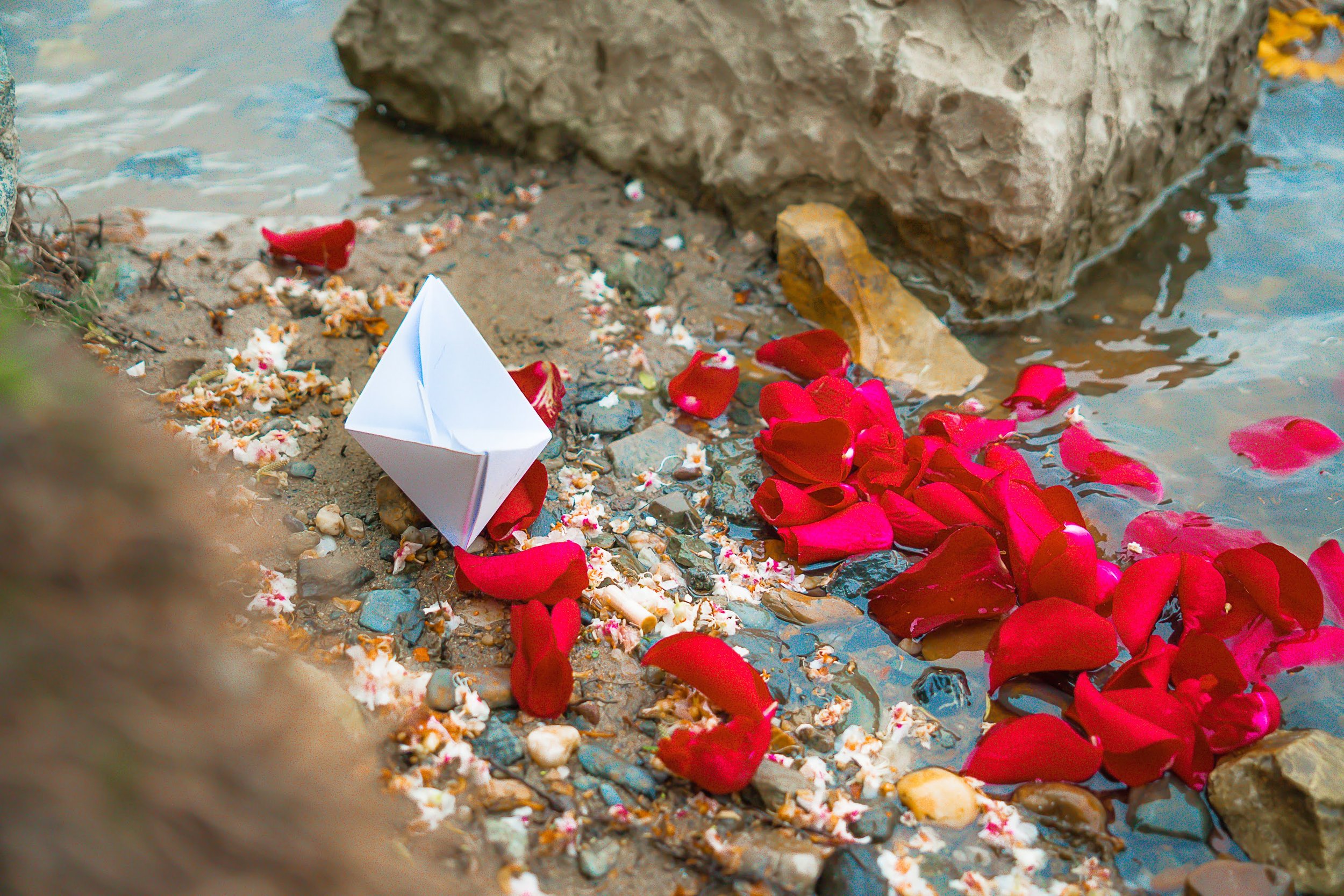
So if you have a strongly religious family, but you want to scatter the ashes, consider it and try to think of other ways, perhaps doing it only symbolically. You can, for example, throw flower petals into the water together as part of the farewell. You can write messages to the deceased on paper boats and send them down the stream… or you can scatter perhaps just a symbolic teaspoon of ashes… There are countless solutions for “handing over” the deceased to the water or earth.
Placing the ashes of the deceased in nature
Are you looking for another way to handle your loved one's ashes? Today, many alternative methods already exist.
Even though placing ashes outside of a cemetery was prohibited until 1988, today ashes are legally just a “thing” that we can do anything with (you cannot, however, inherit them or bequeath them to someone). But you must do everything with respect: we must not violate the dignity of the deceased.
Did your loved one love water? You can scatter the ashes into a river or the sea, for example. If you choose to scatter them in water, you will need permission from the river authority. We at Funeral Guides can help you with that. It is not simple, but it can be done. In contrast, we do not need any permits for scattering at sea.
Another option is scattering the ashes in nature. Choose a place the deceased loved, where they liked to return. It could be a meadow or a hill, for example. Or you can bury the ashes in the earth, perhaps near a tree you plant in honor of the deceased. This is completely legal and quite common: however, you must have the permission of the landowner. Or you can do this in your own garden or meadow. You can also easily make arrangements with a local tree-lined alley or a forest owner. Especially the tree-planting ceremony is beautiful, symbolic, brings the bereaved together, and leaves a living memory.
It is worth adding that ashes do not contain anything that would harm nature; they are just inorganic substances, primarily limestone. We won't even find any bacteria in them because the body goes through heat of around 1,000 degrees Celsius in the crematorium. When you throw a banana peel or foreign fruit containing bacteria in nature, you actually cause greater ecological harm. Furthermore, the ashes serve as good fertilizer for the tree. (We must admit, however, the fact that no one knows for sure how many heavy metals may be in the ashes, which we accumulate in our bodies throughout our lives. No one measures this yet, and there aren't many ways to do it).

Placing ashes in a cemetery
Have you decided to place your loved one's ashes in a cemetery? How to proceed?
If you choose a cemetery, you have several options.
You can place the urn with the ashes in a grave or a tomb. A columbarium is also an option—a good solution for anyone who knows they cannot care for a grave long-term.
If you already rent a grave, you can place another deceased person in it—there is plenty of space in a grave. You can place the urn in the grave yourself, or with a stonemason who will help you with the marble slab. You don't have to ask the cemetery. Cemetery management usually offers assistance with placement on weekday mornings, which we do not consider an ideal time for saying goodbye. In our opinion, a weekend, or at least an afternoon or early evening, is much more suitable when you will have enough time and space. It is also good when the placement is accompanied by at least a small ceremony, during which cemetery staff may naturally not want to stand aside and wait for the ceremony to finish just to slide the marble slab in at the end.
However, we must follow the cemetery regulations during placement. Some cemeteries do not allow burials in winter. We don't know why ourselves, it's simply a winter regime. If you want to place an urn in winter, try contacting us, we will try to arrange permission—but we promise nothing. After placement, you must also report to the cemetery administration who and where you placed. But please: do not place pets in graves. We understand they were family members too, but our legislation does not allow it, nor is it any long-standing tradition. Yet sometimes we happen to hear: “When you are digging, watch out—up on the left lies Kitty…”
What will happen at the funeral?
What will be at the funeral service—a casket, an urn, or just a photo of the deceased?
If you choose for the body of the deceased to undergo cremation and then hold the memorial service only with the urn of ashes, you gain the advantage that there is no need to rush. The date for such a farewell can wait as long as needed. Saying goodbye with an urn is now accepted and offered by the Catholic Church in churches as well.
You will always receive the ashes in a simple, securely sealed hard plastic urn. If you know in advance that you will be scattering the ashes or a part of them, you can notify the funeral home beforehand—they will not seal the urn as airtight, and it won't be necessary to get into it with a knife or drill. In better funeral homes, you will receive the urn in a cloth bag (sometimes free, sometimes for an extra fee), in worse ones in a plastic bag. For the purposes of the ceremony and displaying at home or in a columbarium, people therefore often order additional decorative urn covers—ceramic, glass, wooden, metal, plastic, stone, eco-friendly paper, etc.
If you choose to have the casket with the body of the deceased present at the funeral, you have more options—leaving the casket open the entire time, keeping it closed the entire time, or allowing a peek into the open casket before the official start of the service. We recommend hurrying more with casket services because every day of refrigerating the body of the deceased is paid for. After the service, the casket goes either to the crematorium for cremation or to be buried in a grave. You choose the exact model of the casket from a list at the funeral home (such caskets are usually available immediately), or there are companies that will manufacture a casket exactly according to your wishes (though expect production to take several weeks).
The advantage of a burial is that it allows you to be in contact with the actual body and much better realize that your loved one is no longer here—and won't be. A burial also leaves a significantly lower ecological footprint because the body does not undergo cremation. You can find details about our ecological funerals on the Ecological Funeral page.
It is not uncommon to organize a farewell without an urn or a casket, perhaps just with a photo of the deceased or a funeral wreath. The most important thing is for all the bereaved to be able to gather together and reminisce.
If a casket, an open one or rather not?
Lifting the lid of the casket before the service is called “identification of the deceased” and is done solely at the request of the bereaved (no one should force you into it if you haven't expressed an interest). The bereaved sometimes request identification to gain certainty that they are truly saying goodbye to their loved one, but especially so they can see their close one's face one last time. Besides that, the service can also be held with an open casket the entire time.
You may be asked about your wish for identification at the funeral home when arranging the service. Whether you answer yes or no here, no one should prevent you from seeing the deceased before the service if you decide to do so at the last moment. Likewise, you have the right to change your mind if you find out in the ceremonial hall that you do not have the necessary strength for it—there is certainly nothing wrong with that.
The body indeed looks different than it did in life. The skin has a different color, the spark is missing from the eyes, the face loses its familiar expressions, the body is stiff and cold, looking somewhat like wax. Sometimes it isn't possible to close the deceased's eyelids, sometimes even their mouth. Although this is a natural process, not everyone can process the experience of looking at their loved one like this. Seeing a close one this way from one second to the next, without warning and without observing what happens to the body from the moment of death until the funeral, can be very traumatizing. In the era of dying in hospitals, we are not commonly used to such a sight. Ultimately, however, it is entirely up to you whether you evaluate identification as a suitable way to accept the fact that the person is no longer alive, or whether you forgo identification out of fear that your strongest memory of the person will be their post-mortem appearance. Neither choice is wrong, though it is wise to think about it. Neither choice can be taken back—seeing a face that can no longer be “un-seen” can be just as difficult for some as it is for others to reproach themselves for not having the courage to do it.

How to choose the place where the funeral will take place.
The atmosphere of the funeral and possibly its connection to the life of the deceased are heavily influenced by the chosen venue for the ceremony. It should be pleasant, personal, and accessible even for older bereaved guests. It helps when there are two separate spaces, and restrooms are convenient. If you want to stay indoors, it can be a historic villa with a terrace and garden, a church or chapel, a lounge (in a theater, gallery, restaurant, or hotel), a gallery or museum, a ceremonial hall, a community center, a library, a loft or rooftop, a cafe, bar, or club, a botanical garden, a planetarium, or even a gym or sports hall. Check out our page Indoor ceremony venues for more details. Outdoors, we recommend places by the water (an island, river confluence, weir), places in a park or at the edge of a forest, meadows, and viewpoints. Villa gardens (as well as private gardens), garden gazebos, and even spaces near a church or at a cemetery are fine. The most important thing is that the place is personal—for you and your loved one… If you wouldn't know what to do about the venue yourself, we have a detailed map of places in Prague and the Central Bohemian Region and are gradually mapping Brno, Ostrava, Pilsen, and other cities where we also hold ceremonies.
The ceremony does not have to take place only in ceremonial halls, and you certainly do not have to choose from the funeral home's hall catalog. You have the right to hold the ceremony at a location of your choice. Don't be afraid to ask and stand by your idea.
Think about the specific format of the funeral service.
The ceremony should be dignified and help the bereaved, while remaining true to the wishes of the deceased—and complying with the law. It certainly doesn't have to be purely somber; it can also serve as a celebration of life.
A ceremony helps the bereaved most when they actively participate. It is much like learning—we absorb information best when we engage our senses: hearing, seeing, reading, writing… The bereaved can share memories by speaking a few words or even a longer eulogy during the service. They can also remember quietly, such as by writing messages that are placed into the coffin with the deceased. They can sing together, plant a tree, or light a candle for the departed. They can prepare a collection of photographs in advance, either printed or displayed on a screen, or gather stories written down by friends and acquaintances. At the funeral, guests do not need to simply sit passively listening to the main speaker before leaving. Everything can be arranged and tailored differently.
To make the ceremony as personal as possible, you can create a unique obituary notice, choose an unconventional coffin, select specific music favored by your loved one, or opt for particular flowers, color shades, candles, a cohesive style, photo presentations, a video, refreshments, a memory corner, directional signs, keepsake items, or a memorial website. Any or all of these can help you truly experience the funeral in a way that honors how the deceased lived. For a better idea, you can read the article How to make a final farewell as personal as possible? and its continuation A funeral doesn't have to be draped in black.

Decide who will write and deliver the main eulogy.
Our process works as follows: we arrange an online interview lasting about an hour (an in-person meeting can also be arranged, but an online call is usually more convenient for both parties), during which we ask you all about your loved one. It is important for us to see when you smile while telling a story, what details you repeat, and what you emphasize as truly characteristic of them. This conversation doesn't need a strict structure—we can weave the final eulogy together from your stories. We take the preparation of the speech very seriously, spending several hours on it, and we also factor in additional time for revisions. We feel this is the right approach, as we consider the main speech to be the central focus of the farewell.
We send every speech to you in advance for edits, comments, trimming, or additions, ensuring you are completely satisfied with the final version. Because we work in a shared document, changes can be made right up until a few hours before the ceremony. We see this as our added value, along with the fact that we have a team of speakers who can deliver the speech for you—while naturally mentioning that we drew from the stories of specific people and did not know the deceased personally. This allows you to focus more on your emotions and experiencing your grief during the ceremony, rather than stressing over whether you will be able to speak in front of people.
However, some people prefer to take on this "duty" themselves and prove that they can do it. We fully support anyone who wishes to do this and do not insist on using our speakers. In such cases, we can at least help draft the speech or, upon request, review the one you wrote.
In cases of very traumatic losses or other exceptional situations, you or we might feel that it is too early for a eulogy, and that you would prefer to hold another gathering perhaps a few months later where words will be spoken. A lovely ceremony can be held even without a central eulogy if you choose another focal point for the event (such as a memory table, lighting a candle, writing a message on a board, etc.). Alternatively, you may not feel it is appropriate to share funny life stories yet; in that case, we can create a brief, sensitive speech that leaves space for each mourning guest to say a silent farewell.
What flowers or decorations should be at the funeral?
You definitely don’t need to order funeral wreaths for a funeral—they’re expensive and serve no further purpose after the ceremony. Instead, we recommend bouquets that you can take home after the service to put in a vase, donate to a church, place on someone’s grave, use as decoration at work, and so on. Flowers don’t carry the stigma of a funeral—they can continue to bring joy regardless of where they were originally purchased. If the bereaved take the flowers home themselves, they can also serve as a metaphor for the transience of time and the gradual passing of life. While this seems like the right approach to us, we also understand when a family isn’t yet ready to accept this loss and chooses to embark on their journey through grief later—even without flowers.
Another option is to order just one large bouquet for the urn or casket and not worry about any others—either the bereaved will bring their own, in which case you, as the funeral director, won’t have to take care of them, or you can ask the bereaved not to spend money unnecessarily on flowers, explaining that one central arrangement is sufficient.
If this matters to you, you should know that flowers are one of the biggest environmental burdens at funerals, which is why we try, at the very least, not to throw them away. The bereaved can take them home (there’s nothing strange about that) or use them to decorate the grave. If they don’t want them, we have arrangements with churches that are happy to use the flowers as decorations (except during Lent, when churches aren’t decorated). If our ceremony takes place in a church or chapel, the flowers are often used right there. Alternatively, we can place the flowers in the cemetery—most cemeteries have a communal grave or a large cross… The last option is to decorate war memorials, which can be found in almost every town. You can read many more details on our page on eco-friendly funerals.
Instead of flowers, or along with them, you can also decorate the space with various mementos that reflect the life of the deceased. A soccer ball, a favorite drink, a teddy bear, a hockey jersey, red pumps, a hat… You can also get creative with a photo display board, a slideshow of photos from a projector, etc. (we can help with all of that). You can also ask those attending the funeral to help set up a memorial table, corner, or display board. Surely one of them will be able to bring something that symbolizes the deceased to them.

Prepare the obituary notice.
Don't be afraid to choose a personal obituary notice that you like, that reflects the deceased person, and that they likely would have appreciated. Your obituary notice certainly does not need to feature a dove on the left and a cross on the right. You can find our obituary notice templates on this page.
It should include where and when the farewell gathering is taking place, along with any additional details about its format. People appreciate guidance and reassurance, so the notice can also contain more specific instructions for the ceremony: for example, a request that attendees do not bring flowers or wear black, or conversely, a request to bring a short story to share. It is also helpful to state or at least briefly hint at the cause of your loved one's passing, as family and friends would likely ask anyway, and sharing this can make things more comfortable for everyone.
Practical details, such as parking information or a precise map, can serve as supplementary info. This will save you many questions, though this information probably doesn't belong directly on the main obituary notice (the exact address is sufficient there).
Invite family, close friends, and acquaintances of the deceased to the ceremony.
Nowadays, there is no need to rely solely on obituary notices sent via postal mail. You can email the invitation to the funeral service, post it on social media, or quickly set up your own webpage. In addition to mailing printed notices, you can deliver them yourself to a workplace, the notice board of the cemetery where the deceased will be laid to rest, a school, a favorite club, or a preferred café or pub. You can even hang notices on lamp posts if your loved one was primarily known by local dog walkers on neighborhood streets. You can also send a simple informational text message explaining what happened and when the farewell gathering will take place.
We at Funeral Guides can print and mail notices for you, send them via email, and text the bereaved. If people reply, we can handle ongoing email inquiries and condolences from the mourners on your behalf.
