
Would you like a tree to grow from your body? And did you know that isn't possible here? Ekonews reports on the conference Together for Terramation
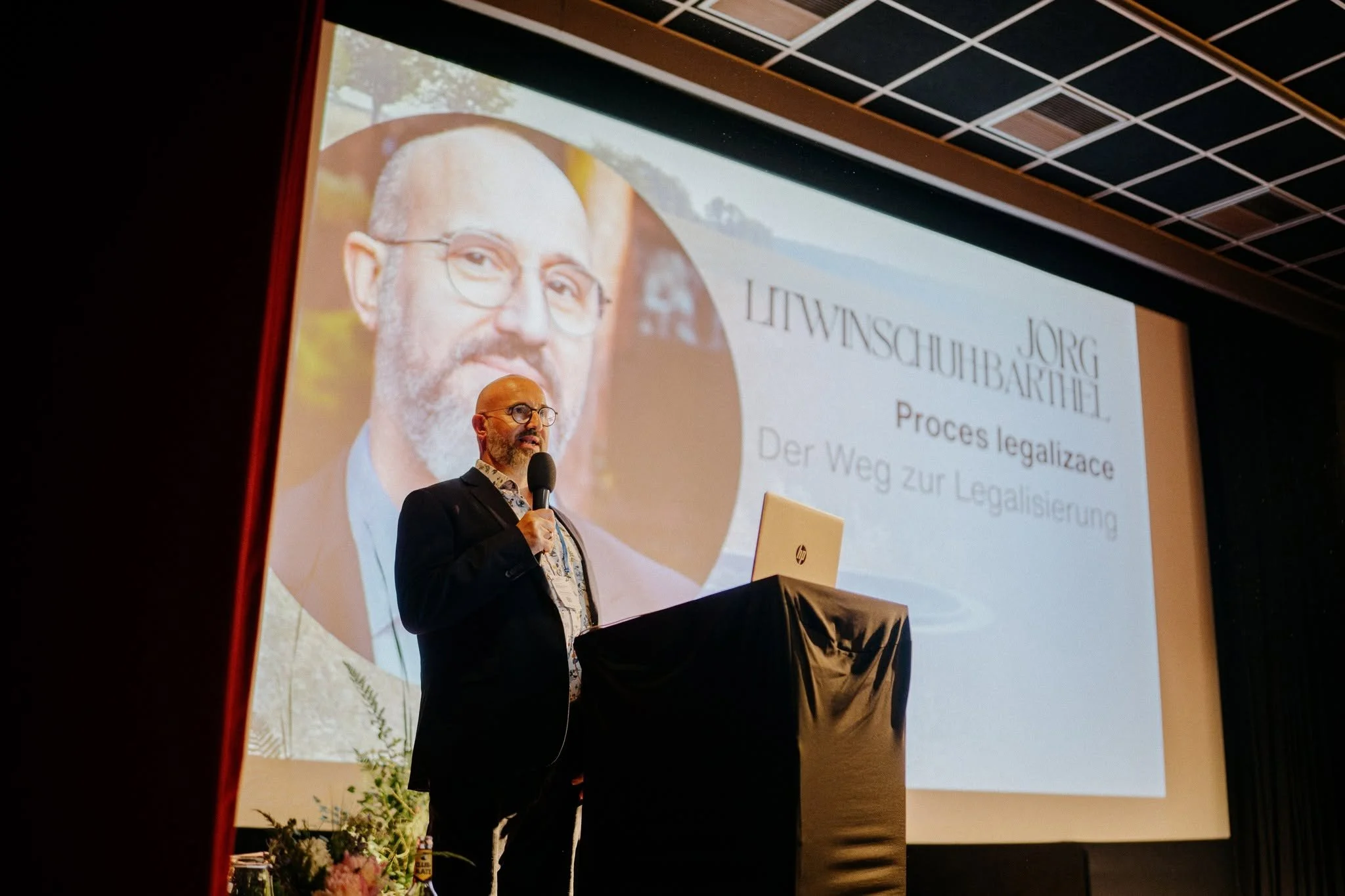
Jörg Litwinschuh-Barthel on the legalization of terramation
Would you like a tree to grow from your body? And did you know that isn't possible here?
Well, not quite: here, any tree burial must be preceded by cremation. So only your ashes are poured around the tree. And since ashes are mostly phosphorus and calcium, the tree mostly just tolerates you rather than being helped to grow by you.
(A rarer exception is, of course, cemeteries where trees were planted and then allowed to grow so wildly that their roots grew through the graves. No one can be newly buried there in a coffin without cutting down the tree, but it's proof that it is possible – when there's a will!)
But how to make it actually possible? How to truly transform into useful soil that gives rise to a tree? And how to do it within dozens of days, when a body normally takes decades to decompose?
This is what the German company Meine Erde looked into. They came up with a "cradle" where a deceased person's body decomposes in 40 days through natural processes: moisture, warmth, and gentle movement. Once the process is finished, you are left with terramate – soil, earth, in which a tree can theoretically be planted.
Except: even in such a progressive country as Germany, this soil must be transported to a cemetery and buried several meters deep.
And now the crucial question – can we do this here as well?
No funeral home has the technology (the cradle) to do this yet. But we don't see any problem with that: we can arrange the transport of the deceased to Germany, and then the transport of the terramate back to us. We will take care of the necessary paperwork.
However, it would be completely ideal without transport and without issues with our laws. This is what the Last Trace association, led by Adam Vokáč, is striving for.
The ministry's statement reads (among other things): "Ecological criteria and moral sentiments can diverge significantly, while in the field of burial and handling human remains, a violation of the public's moral sentiment is judged as a potential offense under the Burial Act."
So what do you think? Is it an offense? Is it an ecological problem? Is it a violation of public moral sentiment in a place where, according to the ministry, cremation is not considered such a violation?
Read the article by Irena Buřívalová on Ekonews about the conference organized by Adam Vokáč and the Last Trace association, which was also attended by our Oleg Vojtíšek: