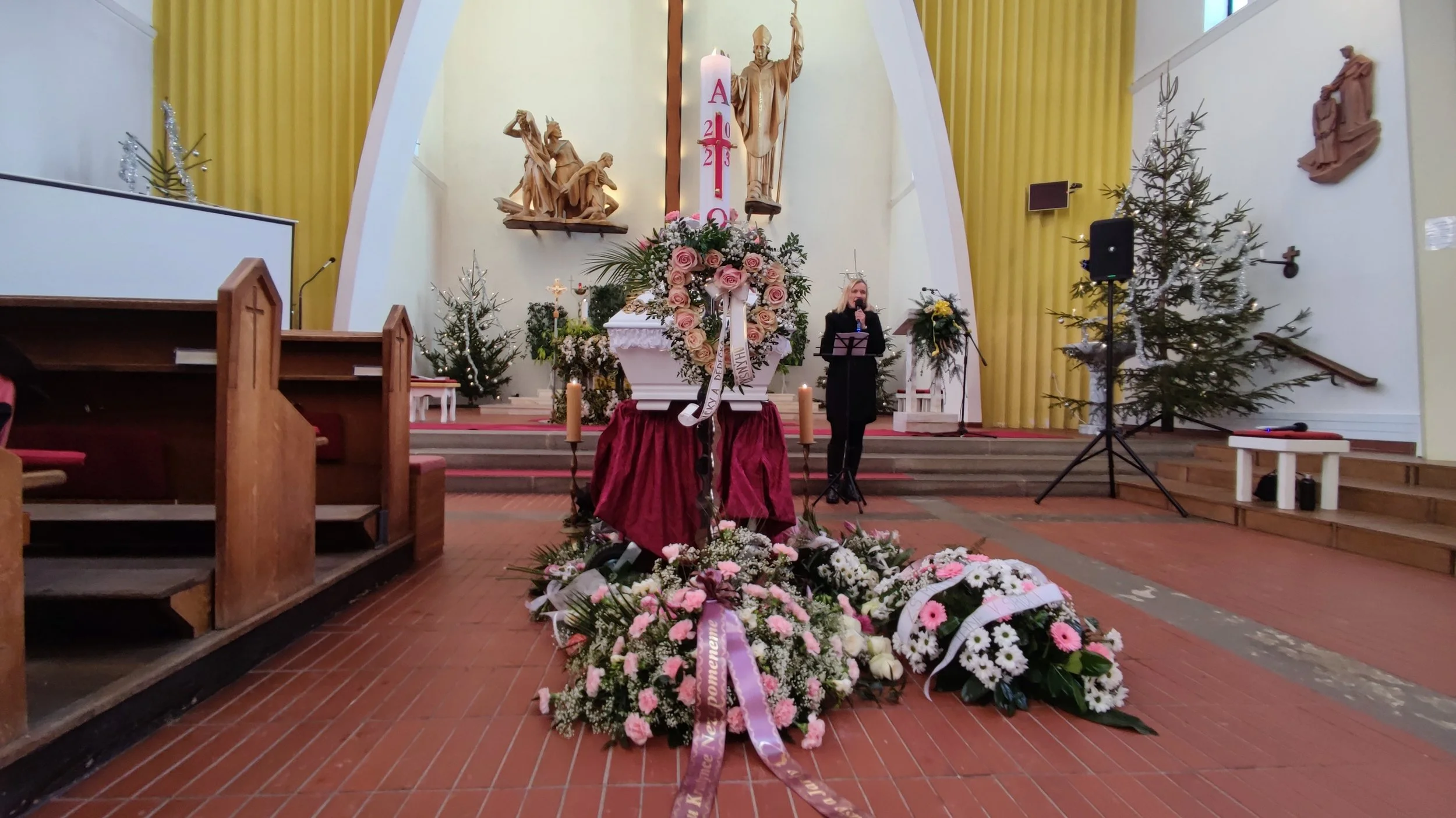
FLOWERS FOR A FUNERAL
Traditional funeral arrangements usually consist of roses and lilies. The wreaths are typically as large as possible and feature black ribbons with the words “In Memoriam” written in gold. In the past, roses and lilies served a practical purpose: they were brought home to the deceased, whose body was often laid out there for several days. Their scent thus masked the unpleasant odor that the body might emit.
That’s no longer the case today: flowers don’t conceal death, but rather celebrate life. So why limit ourselves to just roses and lilies? We believe that flowers serve as a gift: a final symbol of love that you give to the deceased on their journey. They should therefore be personal; they should remind us that life is born and dies, that it is fragile—because even beautiful flowers eventually wilt and wither.
We don't let you choose a wreath from a catalog. We ask: What was your loved one like? What did he or she enjoy? And what did you love about him or her?
Examples of funeral bouquets we have arranged:
A bouquet of yellow tulips for a grown man, because the deceased used to steal them for his girlfriend from the neighbor’s garden—after the funeral, she took it home as the last bouquet “from him.”
A lily arrangement with colorful pinwheels for a little boy, because he loved watching windmills and generators spin.
A flower arrangement with rock plants for Grandpa, because he used to grow them in his garden.
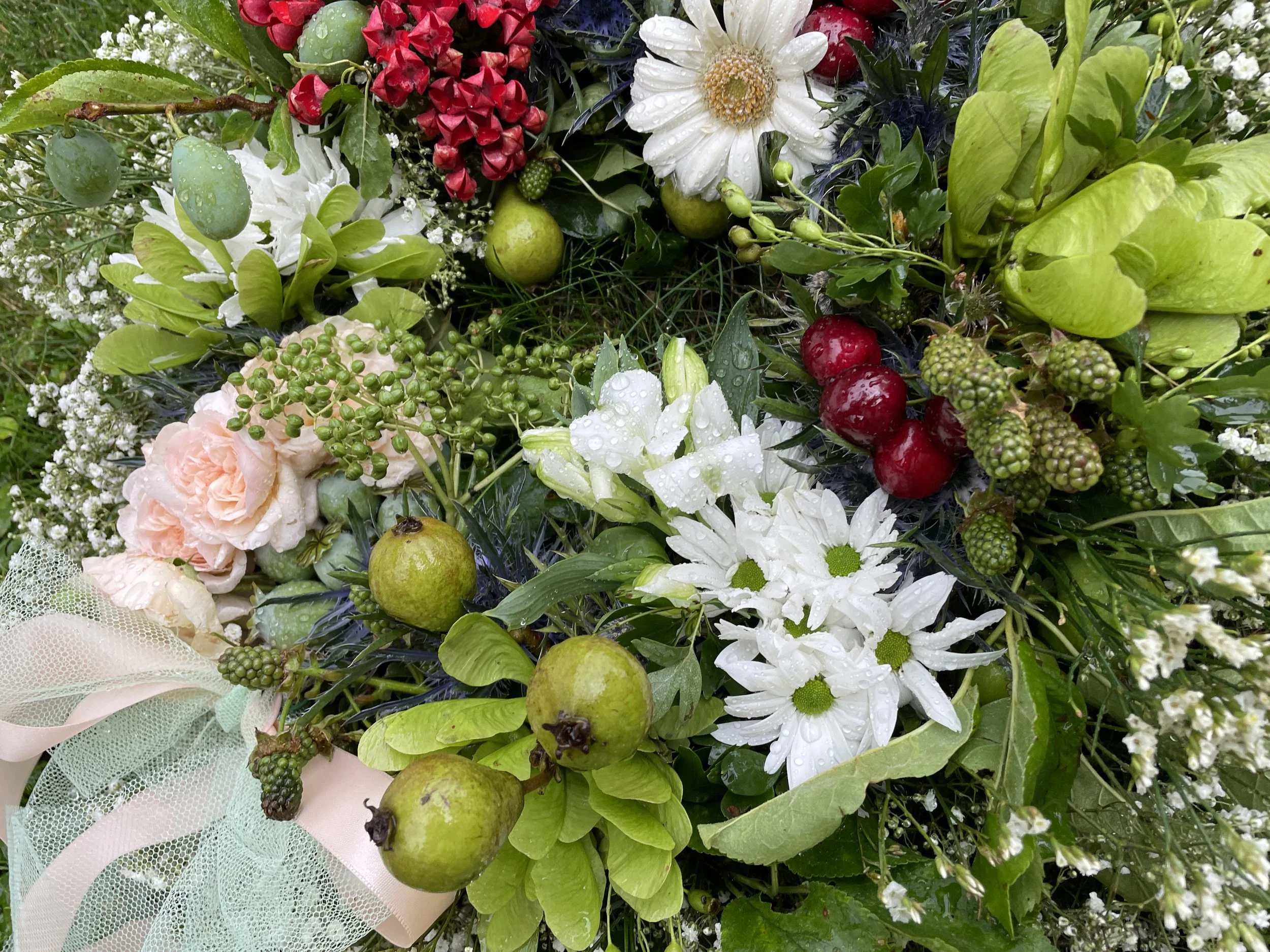
Or a wreath made of cherries, poppy heads, and other fruits for Grandma, the gardener
And many others featuring bunnies, tools, sports equipment, and other personal accessories...
We don’t order exotic flowers that have traveled halfway around the world, because the most beautiful ones are already right here at home. We receive requests like, “Grandpa loved his rock garden; he loved going mushroom hunting and walking in the woods,” or “My sister loved wildflowers, and her favorite color was blue.” This results in beautiful, personal arrangements—sometimes made simply from twigs and berries, but also featuring fruits from the garden, or even flowers wrapped around a tennis racket.
We always strive to find a balance between local, seasonal flowers and the family's personal wishes.
What do we recommend?
Don't order a bunch of giant wreaths. Order just one, and take the time to make sure it reflects a bit of your personality.
Expect that guests will bring flowers anyway. If you’d like specific flowers—or, conversely, no flowers at all—make that very clear in the obituary. Some people ask that, instead of flowers, guests donate the money they would have spent to a charity—and even include a QR code for a specific fundraiser. Why not? We can set up a fundraiser for you.
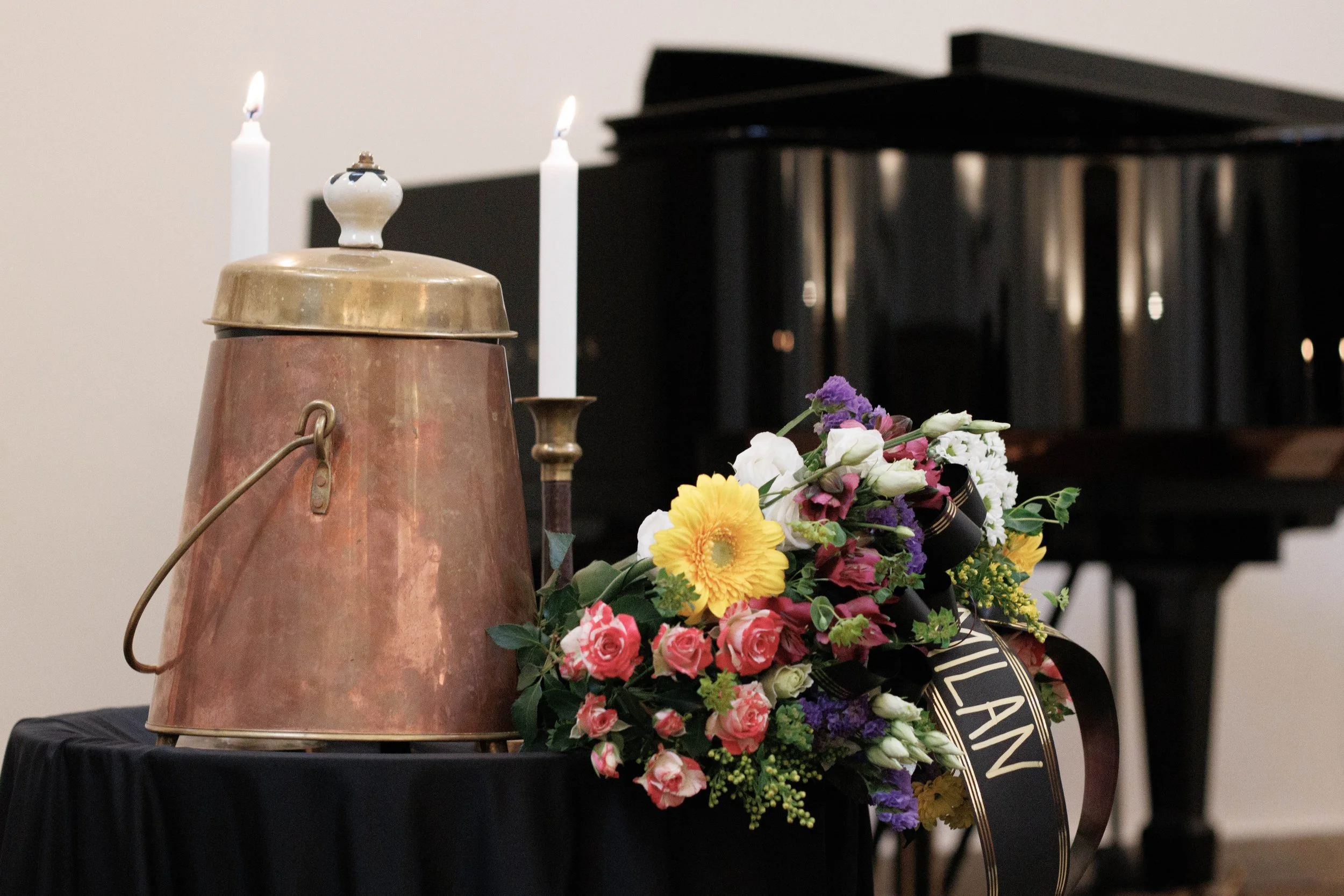
If you use ribbons, write something personal on them. For example, at a musician’s funeral, we had one that said, “It’s not the end, just a different stage.”
Try looking around you: is it winter and is the frost biting? If so, maybe you shouldn't get sunflowers.
Last but not least: feel free to go out to the garden and pick something yourself. It’s not rude—it’s beautiful and personal. If Mom has been receiving tulips from the garden from her son during every visit in recent weeks, let her have them now, too. What’s more—let her have them in her coffin, let her hold them in her hands as she journeys on. When we use our hands, eyes, and even our sense of smell to prepare the flowers, it can be very healing. All the while, we’re actually saying goodbye to our loved one: intimately and in our own way. And our brain gets used to the fact that they’re no longer here and never will be again.
What do we do with the flowers at a funeral?
We’ll design them with you, order them, and deliver them. Maybe we’ll turn them into a flower meadow or a memorial. We know how beautifully a view “into nature” can soothe the soul.
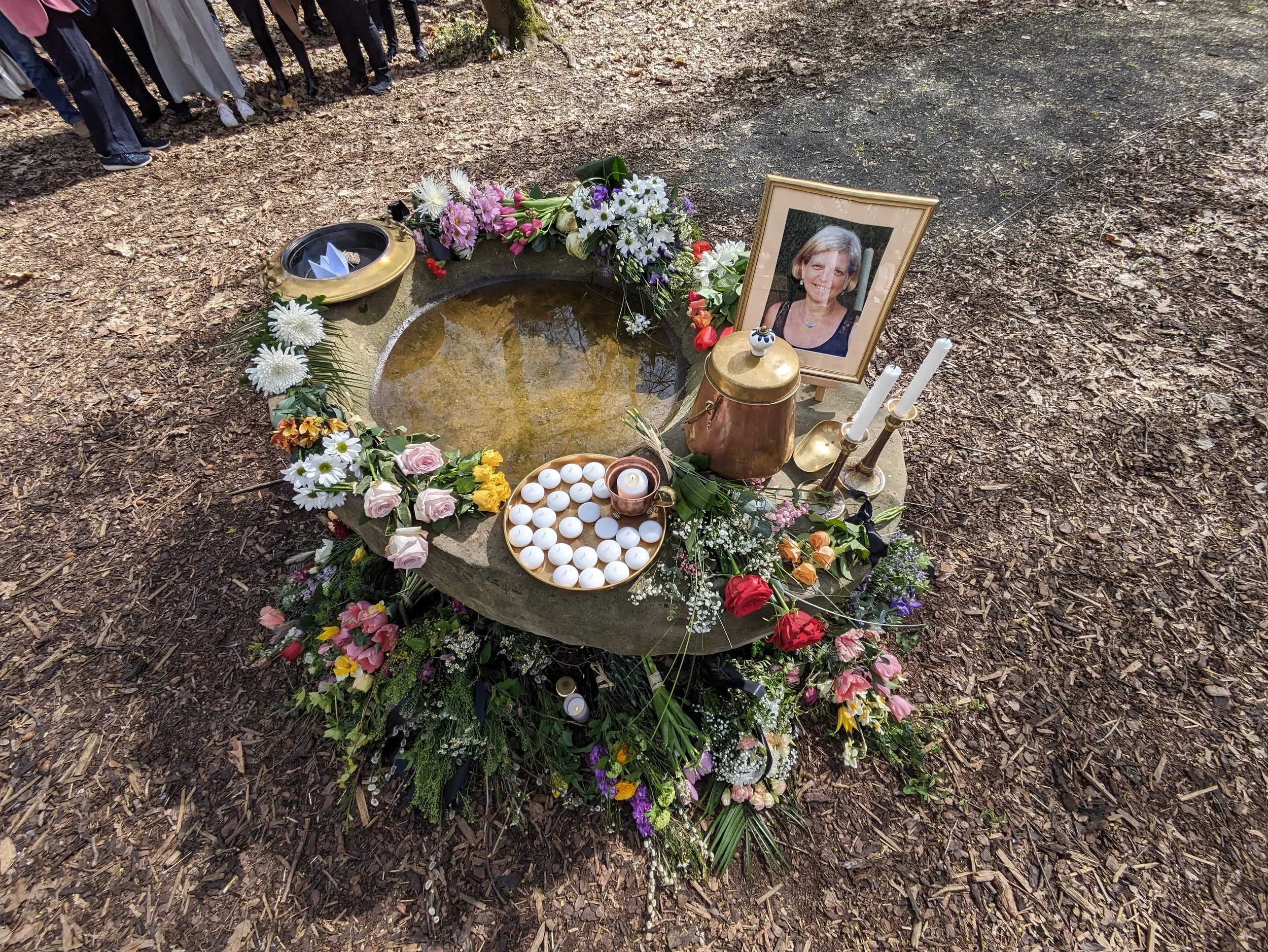
We can also incorporate flowers into the ceremony. Sometimes we send them floating down a body of water; other times, we let the flowers float in a bowl with candles. At the funeral itself, the family can arrange a wreath from the flowers brought by guests (if it’s a more intimate ceremony), or we can use them to create a mandala or another pattern.
What should be done with the flowers after the funeral?
At funeral homes, the answer is simple: into a dumpster and off to the crematorium. We always encourage the family to find another use for the flowers. After the funeral, they serve as a reminder of the shared ceremony.
Offer them to your guests. Take the prettiest ones home for yourselves.
Take them to the graves of your loved ones.
Or we can have them made into a floral arrangement—a keepsake that won’t wilt or fade. Details about the floral arrangement are in a separate article.
If you leave it up to us, we’ll offer the flowers to those who can still make use of them—such as a church or a cemetery. We’ll remove the ribbons, and local visitors will be happy to take the flowers—we’ve had nothing but positive experiences with this. In short, we do everything we can to avoid having to throw them away right away.
The Language of Flowers
When it comes to flowers, it's not just the type of flower that matters, but also their color. If choosing specific types is too much for you, maybe just think about their color—what do you want the bouquet to convey?
White: peace, purity, reconciliation, silence. “Nothing hurts you anymore; only peace remains.”
Red: deep love, a strong bond, respect, and admiration. “I loved you, and that love does not end with death.”
Pink: tenderness, gratitude, a gentle memory. “Thank you for letting me get to know you.”
Yellow: light, friendship, hope. “Your warmth and light live on within us.”
Purple: dignity, spirituality, respect. “Your legacy extends beyond your lifetime.”
Blue: calm, peace, reconciliation, trust. “You depart in peace; the water will wash away your sorrow...”
Orange: energy, life, warmth, memories of joyful moments. “She lived life to the fullest.”
Green: nature, relief, continuity. “The pain has subsided. Balance remains.”
Black: the end, sadness, closure. “It still hurts; I quietly think of you.”
African marigold: It is considered a symbol of mourning, but some interpret it as a symbol of true love. It says, “I never stop loving you.” They bloom from summer through fall, mainly in shades of yellow and orange. You’ve surely seen them before: they are the main symbol of Mexico’s Day of the Dead, placed on graves to symbolize the sun and life.
Thanks to their scent and vibrant color, marigolds are said to help the soul of the deceased find its way back to the family and protect it. But they also wilt quickly: their color warms us, but soon fades—just like life.
Chrysanthemum: a very popular cut flower because it blooms most of the year and comes in many different colors. In Europe, it is a symbol of death for us; after roses and lilies, it is therefore often included in funeral arrangements. In Japan, however, the imperial throne was called the “chrysanthemum throne,” and this flower is used during the Festival of Happiness. This flower says “Goodbye” and symbolizes eternity, love, and truth.
Instead of marigolds, we place chrysanthemums on All Souls’ Day because they express respect and a dignified farewell, as well as a lasting memory.
Eucalyptus: Eucalyptus is a very distinctive type of greenery that has become popular mainly thanks to boho-style weddings. But let’s not forget that eucalyptus is also a medicinal plant, and at a funeral, it can be healing not only for the body but, above all, for the soul. It helps us take a breath (both literally and metaphorically) and purifies the space. It symbolizes protection and new beginnings; for the indigenous peoples of Australia, it represents the connection between the underworld, the earth, and the sky.
Perhaps you feel swept up in the whirlwind of events and are still searching for balance after the death of a loved one. Or maybe you’re planning a funeral to help ease your pain, to bring you at least a little relief. Eucalyptus symbolizes all of this—peace, harmony, and healing.
Gerbera: The gerbera comes in all shades of yellow, purple, and red. It also has a long vase life, which is why florists love it so much. If you’ve ever bought your grandmother a birthday bouquet, it’s quite possible that it included gerberas. It’s a flower of joy and sincerity, most often given as a sign of support: “I’m here for you; you’re my friend.”
The gerbera isn't a flower that evokes strong emotions, but rather one that symbolizes cheerful, sincere friendship.
Hydrangea: The hydrangea originates from Asia, where it symbolizes humility and sincerity. Its Latin name means “water” and “vessel”—because this flower needs a lot of water. We know it as typically blue, but it can also take on a pink hue. It also has its own history here: “Hydrangea” is the name of the charming countess in Božena Němcová’s *Grandmother*.
Its bloom is abundant: just as the life of the deceased was abundant, full of memories. The hydrangea doesn’t shout, but whispers: I’m sorry, I’m here with you, and I’m glad for what we’ve experienced together.
Calla lily: The calla lily is similar in symbolism to the lily. It is just as elegant, just as pure, and just as popular in funeral bouquets, especially since the 19th century. Unlike the lily, however, it is much more resilient: it can withstand cold and wind. Its chalice-shaped flower resembles an embrace, which is why in the church it represents an all-encompassing light. It is also a very common flower in wedding bouquets. But that is actually beautiful—it blends the beginning and the end.
Kala shows us that beauty can be found even in sadness, and that silence speaks louder than a thousand words. If you want to honor the deceased and show them that everything that needs to be said has already been said, then Kala is the perfect way to express that.
Carnation: Who in our country doesn’t know the carnation, or “hvozdík” as we call it! During International Women’s Day celebrations under the former regime, every woman received a beautiful red carnation as a symbol of respect and love. Moreover, because it was used in the past at large, official funerals, many people perceive it as a symbol of “cool dignity.” But the carnation also has Christian significance: according to legend, it “was born” from the tears of the Virgin Mary when she saw Jesus carrying the cross. That’s why it’s also colloquially called “tears,” and its Czech name, “gvozd” (meaning “nail”), which it resembles in shape, even derives from this legend. In Latin, the carnation is called “Dianthus,” after the Greek god Zeus—literally, “Zeus’s flower.”
In America, carnations are bought for Mother’s Day: pink for a living mother, white for a deceased one. In Korea, they are given on Parents’ Day as an expression of gratitude. So the carnation not only has divine origins, but above all, it lets you say, “Thank you, I appreciate you, now rest in peace…”
Daisy: The daisy is a common flower that you’ll see in meadow bouquets (not to be confused with chamomile!). As children, we’ve probably all plucked daisies while saying, “He loves me, he loves me not…” That’s because daisies are believed to have magical properties that can predict the future. They say that if you put one under your pillow, a lost lover will return to you. Whether you’re hoping for a declaration of love or the return of a lost lover, the daisy forces you to do the same thing: wait. You have to be patient; you’re telling it, “I’ll wait for you.”
We associate daisies with childhood: innocence, simplicity, and naturalness. They don’t pretend to be anything they’re not; they aren’t ostentatious. They are a symbol of true, pure love without any complications. Anyone who places a daisy on a coffin is telling others: our relationship was simple, yet profound.
Iris: The Latin name for the iris, *Iris*, refers to the Greek goddess of the rainbow, who served as a messenger between heaven and earth. The iris thus acts as a guide for souls, a flower symbolizing the transition between life and death. It was first mentioned during the time of Pharaoh Thutmose, who is said to have brought it back as spoils of war from the Syrian campaigns. Later, the iris was chosen as a symbol of the Roman Empire. Why? Each part of the flower is said to symbolize something different: one part faith, another wisdom, and the third courage.
The purple iris, in particular, has deep spiritual significance. It speaks of faith and hope. It says, “You’ve given us everything you could; now you must move on and be brave—but you’re not alone; we’re with you.”
The lily: one of the most well-known funeral flowers. It is said to possess a special power—even though it grew in the gardens of temptation, no one touched it, and so it remained pure. It was a symbol of peace and innocence, which is why Christians placed it in the hands of the Virgin Mary (her pious mind is symbolized by the straight stem, her humility by the drooping leaves, her godliness by the fragrance, and her immaculacy by the whiteness). But it is also a symbol of Easter, referring to Christ’s resurrection. In the past, it was placed in the graves of young girls who had not yet fulfilled the “purpose” of their lives—namely, to conceive a child. However, the lily was not always merely a symbol of purity: in the Middle Ages, its symbolism was completely reversed, and the lily became a symbol of unfaithful women. In antiquity, it was a symbol of fertility and sexuality—the flower of the goddess Hera.
The lily shows us the cyclical nature of life and its fickleness: it takes a long time to bloom, but once it opens, it is magnificent. It gradually wilts, giving off a distinctive scent in the process: some love it, others are allergic to it, and for some, it even causes headaches. The lily has become the flower of death because it was believed to restore the soul of the deceased to innocence and purity. You can’t really go wrong with lilies at a funeral—unless the deceased was one of those who hated them, or the family wants to avoid traditional funeral decorations.
Gladiolus: The gladiolus is a beautiful, elongated, colorful flower that looks lush and cheerful. It is also called a gladiolus, from the Latin gladius, meaning “sword.” In the past, victorious gladiators were rewarded with them. As such, it symbolizes courage and bravery. It is a flower that stands proudly and uprightly for its ideals. It is said that if you tie a gladiolus corm around your neck as an amulet, it will help you triumph.
The gladiolus is a beautiful tribute to anyone who was fearless and did not shy away from life’s many obstacles. Or to those who were honorable, followed their inner compass, and fought for what is right. The gladiolus, like the departed, “will not bow its head”—and you, too, must not let pain bring you to your knees.
Daffodil: Daffodils are relatively unconventional funeral flowers, as most of us associate them with envy and the term “narcissist”—that is, someone who is overly self-absorbed. However, the daffodil is a symbol of spring (it is one of the first flowers to bloom), rebirth, and belief in the afterlife. In China, it is traditionally a New Year’s flower; if it blooms for you during the Chinese New Year, your home will be filled with happiness.
In general, the daffodil is seen as a tribute to someone’s beauty; its fragility mirrors the fragility of life. It brings a gentle light and hope into difficult times.
Baby’s breath: Baby’s breath is very often used as an accent flower because its tiny, white blooms break up the monotony and heaviness of a bouquet. But that is precisely its strength: it does not draw attention to itself, but simply highlights the other flowers. It is a delicate flower, quiet and unassuming.
It speaks of pure love and devotion (after all, even its name is associated with marriage), but it also reminds us of the fragility and delicacy of life; each flower represents a fond memory that, in the end, forms the backdrop of an entire life.
Peony: Traditionally, pink peonies are said to attract love, but they also protect you from evil and storms in the garden. Its lavish bloom isn’t just for show: it symbolizes wealth, happiness, and fulfillment. It’s as if it were “overflowing” with powerful emotions.
At a farewell, the peony celebrates human life. It does not weep for the departed or mourn; on the contrary, it symbolizes a life well-lived, full of beautiful moments and deep emotions. The person did not pass away into oblivion—they were loved.
The Rose: The rose is one of the most colorful flowers of all, coming in all sorts of sizes. It is traditionally a symbol of love—as just about everyone knows. Its traditional red color is associated with blood: legend has it that it originated from the blood of Adonis and also symbolizes the blood of Aphrodite, who was wounded by its thorns. It is therefore not unreasonable to consider it a symbol of pain as well—after all, the Virgin Mary is called the “Rose without Thorns,” but we know full well that no such rose exists: nothing is perfect. And everyone is surely familiar with the Rosary: according to a symbolic analogy, each prayer is a rose. When we pray the Rosary, we create a symbolic garland of roses that brings joy to the Virgin Mary.
But did you know that it also symbolizes the transience of life, because it wilts so quickly? The Romans once celebrated the Dies rosationis—a sort of rose festival—in the spring and summer. These were mourning ceremonies during which the graves of the deceased were adorned with roses or violets, because their color resembles blood. The Egyptians, Romans, and Celts all considered the rose to be the flower of the spirits, through which our love reaches the deceased.
For us, the meaning of the rose is clear: “I love you and will love you forever, even after death.”
Sunflowers: Even young children learn that sunflower blooms turn toward the sun. Some see truth in this sun: that is why the sunflower is also a symbol of certain churches; for Christians, it symbolizes Jesus Christ and the love that turns toward God. But even for the Incas, it was a symbol of the Sun God. This only proves how long the sunflower has been important to all of humanity: apparently, stockpiles of seeds more than 3,000 years old have been found in the Americas! That is another reason why the sunflower is a symbol of longevity and vitality.
In addition to its connection to the sun, the sunflower is also significant for its height and color. It symbolizes pride, and sometimes even arrogance (as do most yellow flowers, for that matter). For most people, however, the sunflower is primarily a symbol of life and summer. It brings light and cheer to a somber atmosphere, guides our departed loved ones toward the truth, and reminds us that the sun will rise again one day. Its circular flower, full of seeds, resembles the spiral of life: it spins constantly, never stopping.
Tulip: Today we see tulips in every Czech garden, but in the past, their value was equivalent to that of a house. They were also associated with spring, but today they can be obtained from the Netherlands well in advance at almost any time of year. At first glance, it’s simple—but you’ll soon discover that it has many layers. Its apparent simplicity is elegant, yet it feels warm, almost “homey.” It can have as many meanings as it has colors, but the main one is just as simple: “I just love you, and I’ll miss you.” The tulip does not symbolize sorrow like the lily, nor deep, passionate love like the rose. It is simply calm yet heartfelt.
Examples of our floral arrangements, each with a personal story
-

A Bouquet for Mr. Vladimír
Jawa was a brand that played a central role in Mr. Vladirír’s life. He inherited his love of gardening and nature from his father, so we included plants commonly found in gardens in the bouquet.
-
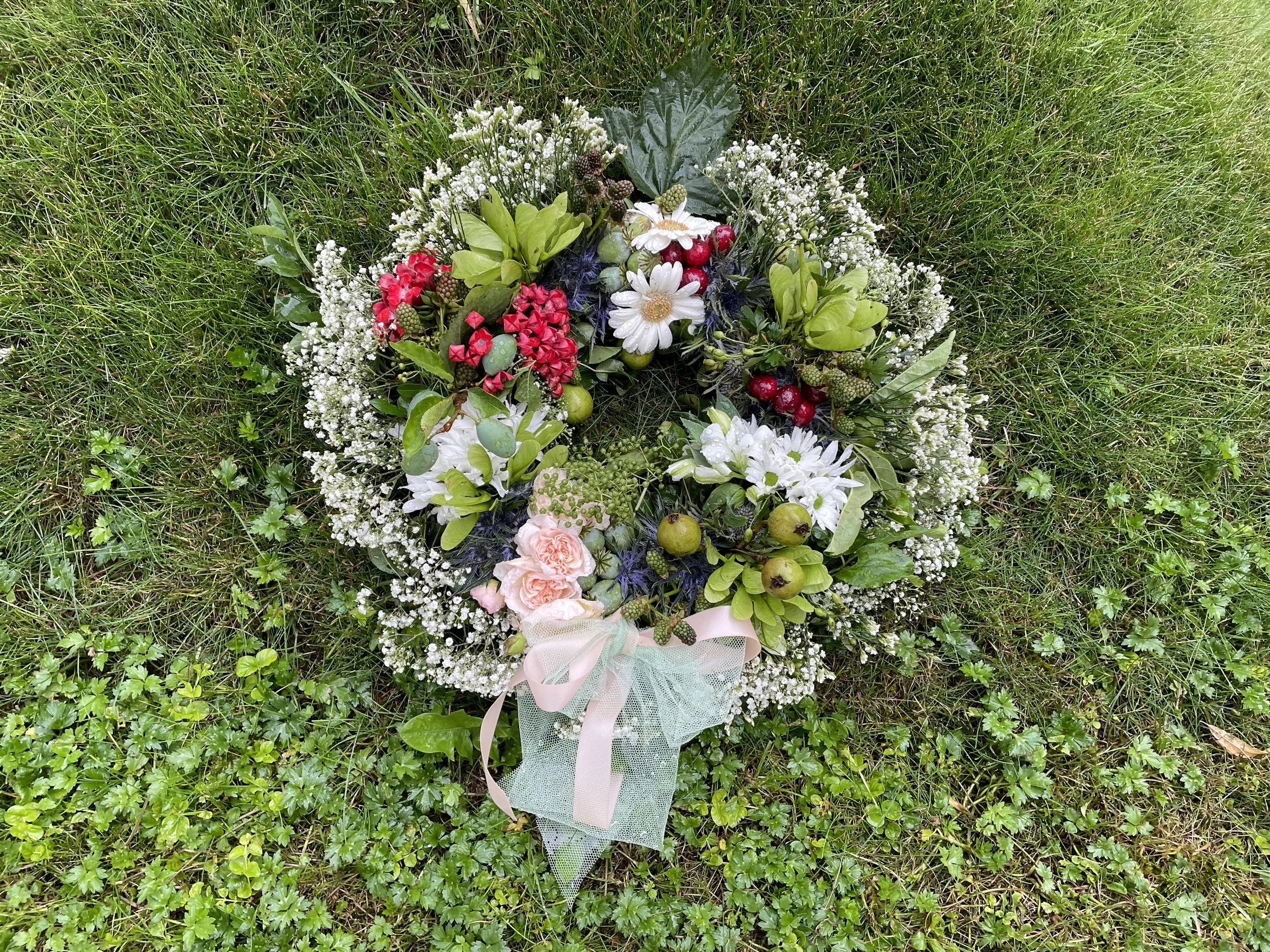
A Wreath for Mrs. Eva
Cherries, pears, raspberries, poppy heads, blackberries, and who knows what else in a wreath for Eva, an enthusiastic gardener from Třebívlice near Lovosice.
-

Flowers for Mr. Jan's urn
Mr. Jan was a trained wood modeler, and this craft sparked his love for wood. He enjoys going on nature hikes and mountain trips with his family, which is why we incorporated wooden elements and wildflowers into the arrangement.
-

Detention for Mr. Josef
Mr. Josef was an architect; he loved austere, functionalist buildings. The family requested a funeral service without any ornamentation or gold accents, and a floral arrangement that would complement the concrete urn. The service took place in the fall, so we chose earthy colors and natural, seasonal elements.
-

A Flower for Mr. Bohumil
Mr. Bohumil was a plant pathologist; he was interested in history, enjoyed listening to music, was sociable and cheerful, traveled, and loved gardening. That is why we chose colorful flowers and plants commonly found in gardens.
-

A Flower for Ms. Zuzana
The Ombudswoman of the Czech Post, Ms. Zuzana, had a small envelope with a crocheted heart in her bouquet. Given the joyful farewell and the planting of the apple tree, we chose wildflowers.